Donor funding cuts hit non-profits hard in 2025. For many, it was the year the money stopped arriving on schedule. Grants were paused mid-cycle, programmes closed, and staff who had spent years building community trust were let go. The figures now confirm what organisations felt on the ground.
Donor funding cuts in 2025: what happened to aid
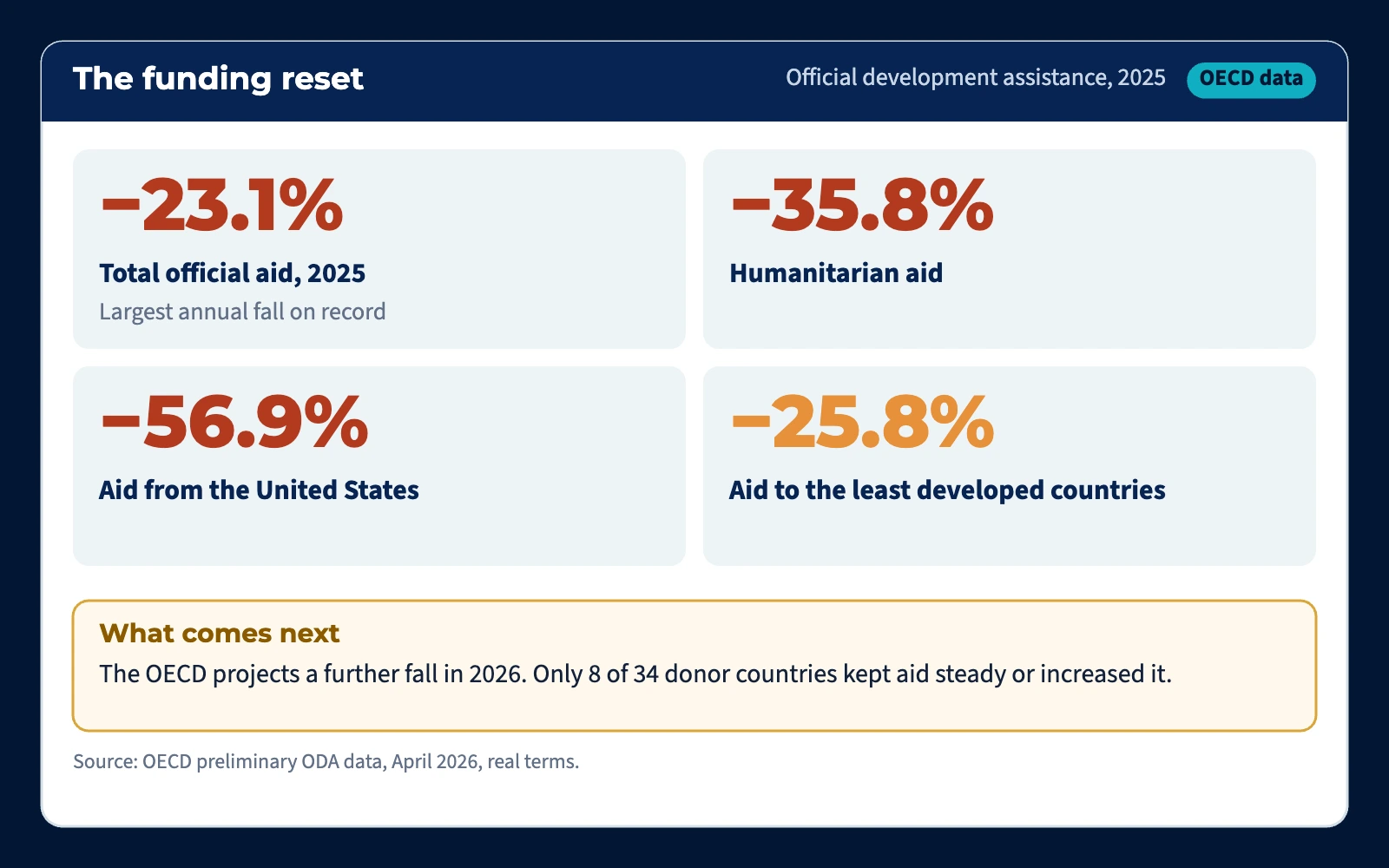
According to preliminary OECD data, official development assistance from its members fell by 23.1% in real terms in 2025, the largest annual drop ever recorded. Total aid came to USD 174.3 billion, or 0.26% of donor countries’ combined national income (DevelopmentAid).
- Aid from the United States fell 56.9%, to USD 29.0 billion, making Germany the largest provider for the first time.
- Humanitarian aid fell 35.8%.
- Aid to the least developed countries fell 25.8%, the second steep fall in a row (Focus 2030).
- Only 8 of the 34 members of the OECD’s Development Assistance Committee kept their aid steady or increased it.
The OECD expects donor funding cuts to continue in 2026. We follow these figures, and what they mean for organisations in Africa and beyond, every week in the Signal Tracker.
Why 2027 is the year donor funding cuts bite
Many organisations absorbed the first donor funding cuts in 2025 and 2026 using reserves, bridge funding and no-cost extensions. Those cushions are running out just as 2027 budgets are set. Three pressures arrive together:
- Fewer, larger grants. Donors with smaller budgets tend to fund fewer partners, with bigger awards and stricter reporting.
- More competition for the same money. Foundations and the remaining bilateral donors are receiving far more applications than before.
- Higher expectations of evidence. Funders asked to show more with less want clear results, not activity reports.
Rising costs add to the pressure
Inflation is climbing again in several African economies, so programmes cost more just as donor funding cuts shrink budgets. The Signal Tracker shows the latest inflation and interest rate figures country by country.
Five decisions for NGO leaders facing donor funding cuts
Know your real runway
List every grant with its end date, amount and restrictions. Work out how many months of core costs your unrestricted reserves cover, and the month money runs out if no new grant arrives. That date, not the annual budget, should drive your next decisions.
Protect the core
Finance, monitoring, safeguarding and leadership are often the first costs cut and the hardest to rebuild. Ask current funders to cover a fair share of core costs, and look at sharing back-office services with trusted peers.
Rewrite the strategy, not just the budget
A strategic plan for an NGO in 2027 should start from the new funding reality. What can only your organisation do? What will you stop? Which partners make you stronger? Cutting every programme by the same percentage protects nobody. Our article on strategic thinking vs strategic planning explains how to make those choices.
Prove your results
When money is scarce, funders back organisations that can show change. A clear theory of change, a logframe, SMART indicators with baselines and targets, and a dashboard that shows progress at any time all make your next proposal stronger.
Diversify deliberately
New income takes time to build, so the work needs to start before the current grants end. The next section looks at the options.
How NGOs can diversify funding
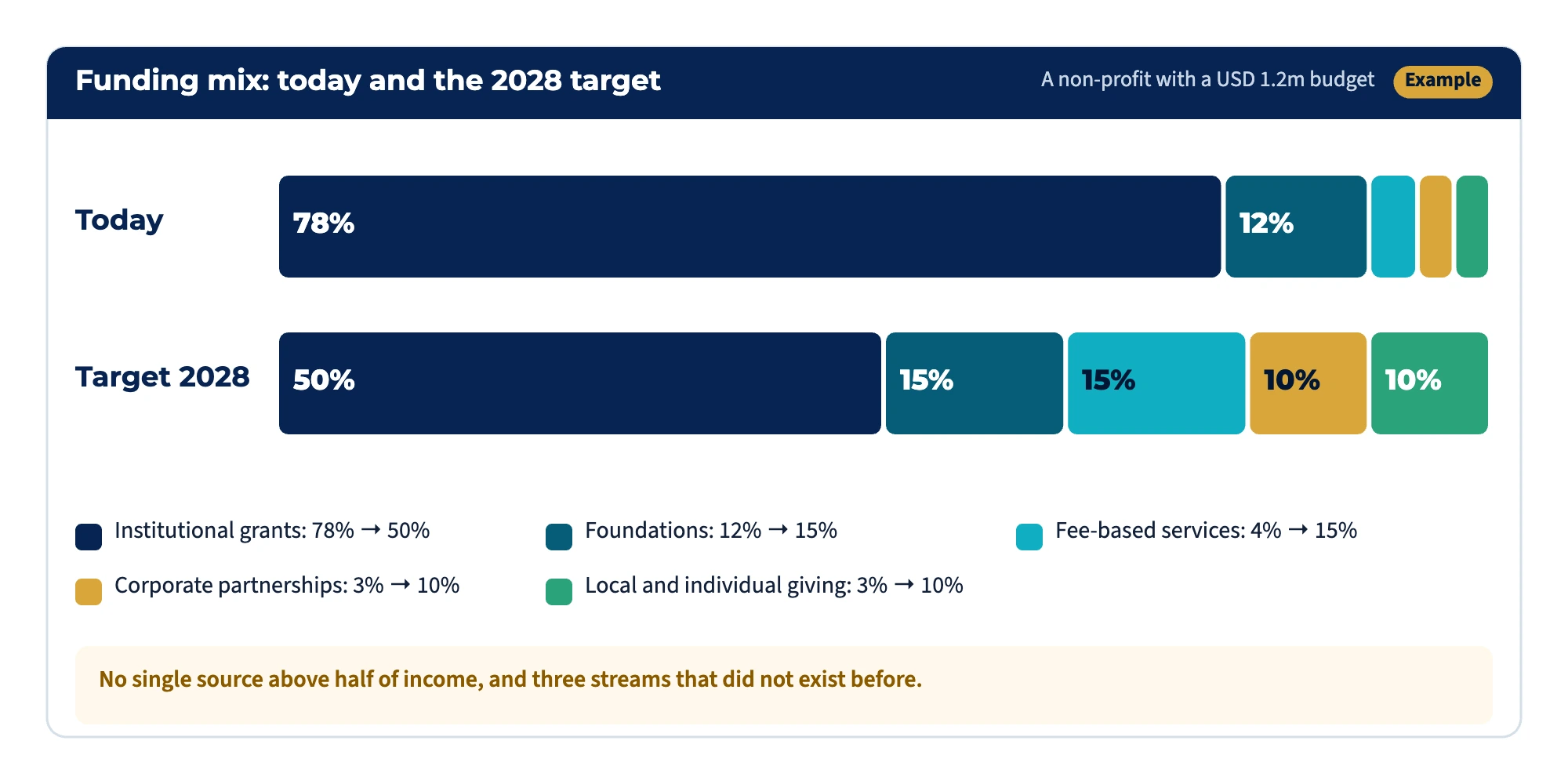
Diversification does not mean chasing every opportunity. It means building two or three new income streams that fit your mission, skills and context, and giving each one time to grow.
| Source | Best suited to | What it takes |
|---|---|---|
| Foundations and family philanthropy | Organisations with clear results and a strong story | Relationships and tailored proposals |
| Corporate partnerships | Programmes linked to a company’s workforce, suppliers or communities | A clear business case. Supplier and ESG programmes are a growing route (see ESG requirements for SMEs) |
| Fee-based services | Organisations with expertise others will pay for: training, research, evaluation | Pricing, contracts and quality control |
| Government contracts | Service delivery at scale | Registration, compliance and patience with payment timelines |
| Consortium bids | Specialists who strengthen a larger bid | Partnerships and a clearly defined role |
| Local and diaspora giving | Community-rooted organisations | Regular communication, mobile giving and trust |
| Blended finance programmes | Enterprise and livelihoods programmes | Strong evidence and financial management |
Four questions before adding a new income stream
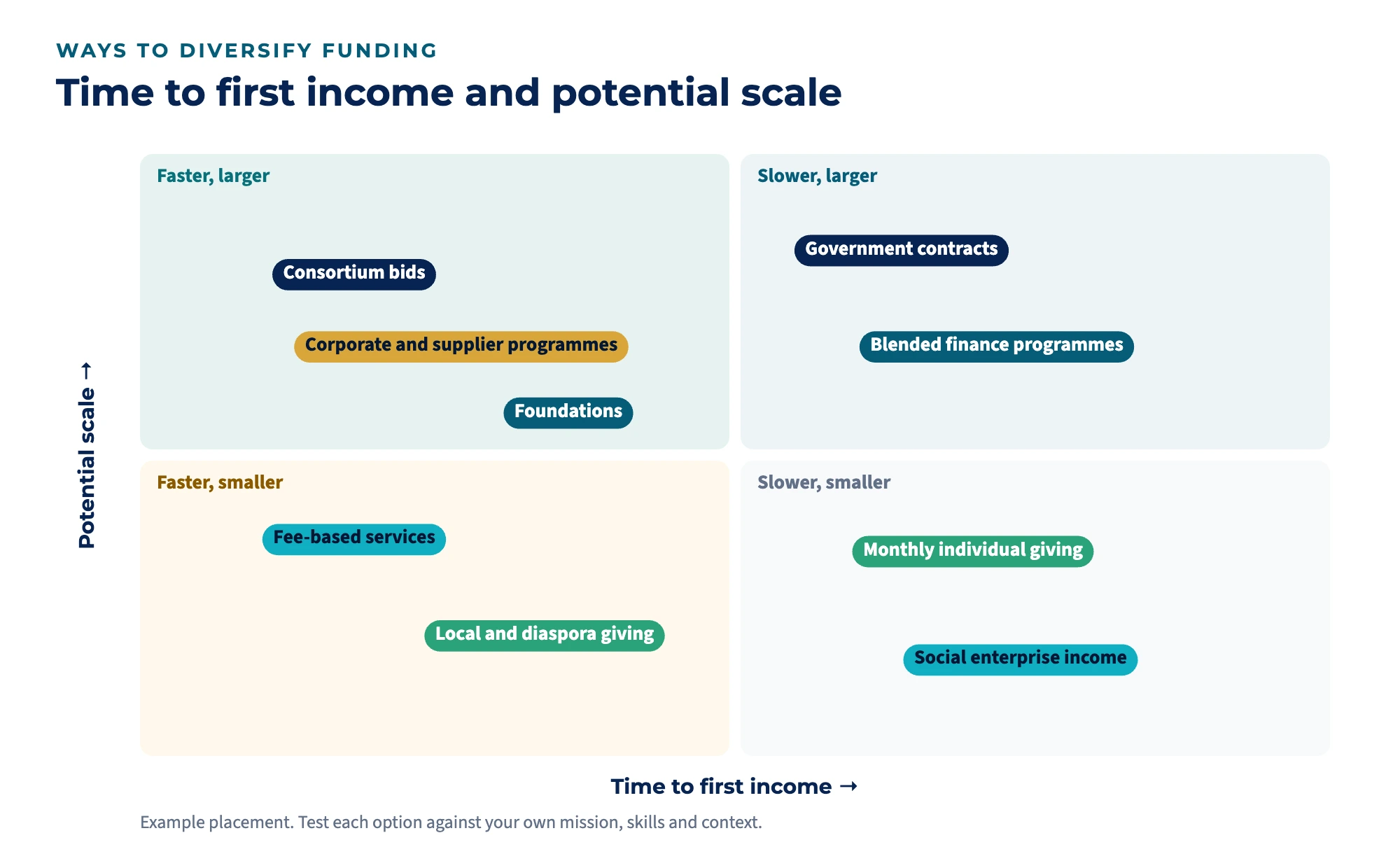
Does it fit our mission? Do we have the skills? Can we wait for the first income? Will it pull us away from the work that only we can do?
What funders can do
Funders shape how well their partners come through donor funding cuts. Longer grants, flexible funding, a fair contribution to core costs and simpler reporting all help. So does investing in partners’ ability to measure and communicate results, which lowers the cost of reporting for everyone.
How Centaora can help
We help non-profits, foundations and donor-funded projects respond to donor funding cuts through strategy, measurement and organisational strengthening. Our Impact System Setup pilot puts in place a results framework with baselines, targets and data sources, and an Impact Dashboard your staff are trained to use, so you can show results to current and future funders at any time. It is open to a small number of organisations; see non-profits and funders.
To start on your own, map your results logic in the free Theory of Change Builder, then track progress in the Impact Dashboard.
Frequently asked questions
How are donor funding cuts affecting NGOs?
Donor funding cuts have paused or ended grants early, closed programmes and cost staff their jobs. Aid to the least developed countries fell by 25.8% in 2025, and competition for the remaining money is rising.
How can NGOs diversify their funding?
Choose two or three income streams that fit your mission and skills, such as foundations, corporate partnerships, fee-based services, government contracts, consortium bids or local giving, and build them over two to three years.
What should an NGO strategic plan include after funding cuts?
Funding scenarios, clear priorities and what you will stop, protection of core functions, a plan to measure results, and targets for new income.
Should NGOs expect aid to recover?
The OECD projects a further fall in 2026. It is safer to plan for lower aid levels for several years and treat any recovery as a bonus.
Show funders what your work achieves
Set up a results framework and a live Impact Dashboard with our team.