
Measuring results of business development services is the part of a business support programme that funders look at most closely. Every programme makes the same promise: the enterprises we work with will be stronger at the end than at the start. Proving it is harder. Attendance lists show who came. They do not show whether a business now keeps records, plans its cash or wins bigger customers.
This guide is for business development services (BDS) providers, incubators, accelerators and government or donor-funded enterprise programmes that need credible results without a large research budget. It covers the results chain, a baseline and endline that compare like with like, and the breakdowns by sex, age and location that funders now expect.
Why measuring results of business development services is hard
- Every business is different. A tailoring business and an agro-processor improve in different ways, so you need measures that work across sectors.
- Change takes time. Sales and jobs often move months after the programme ends, long after the final report is due.
- Owners rate themselves differently at the start. People often overrate themselves before training and rate themselves more honestly afterwards, which can hide real progress.
- Many things affect a business at once. Prices, weather and policy changes all show up in the numbers alongside your support.
None of this makes measuring results of business development services impossible. It means the measurement needs to be planned before the first business is enrolled.
Start with a results chain
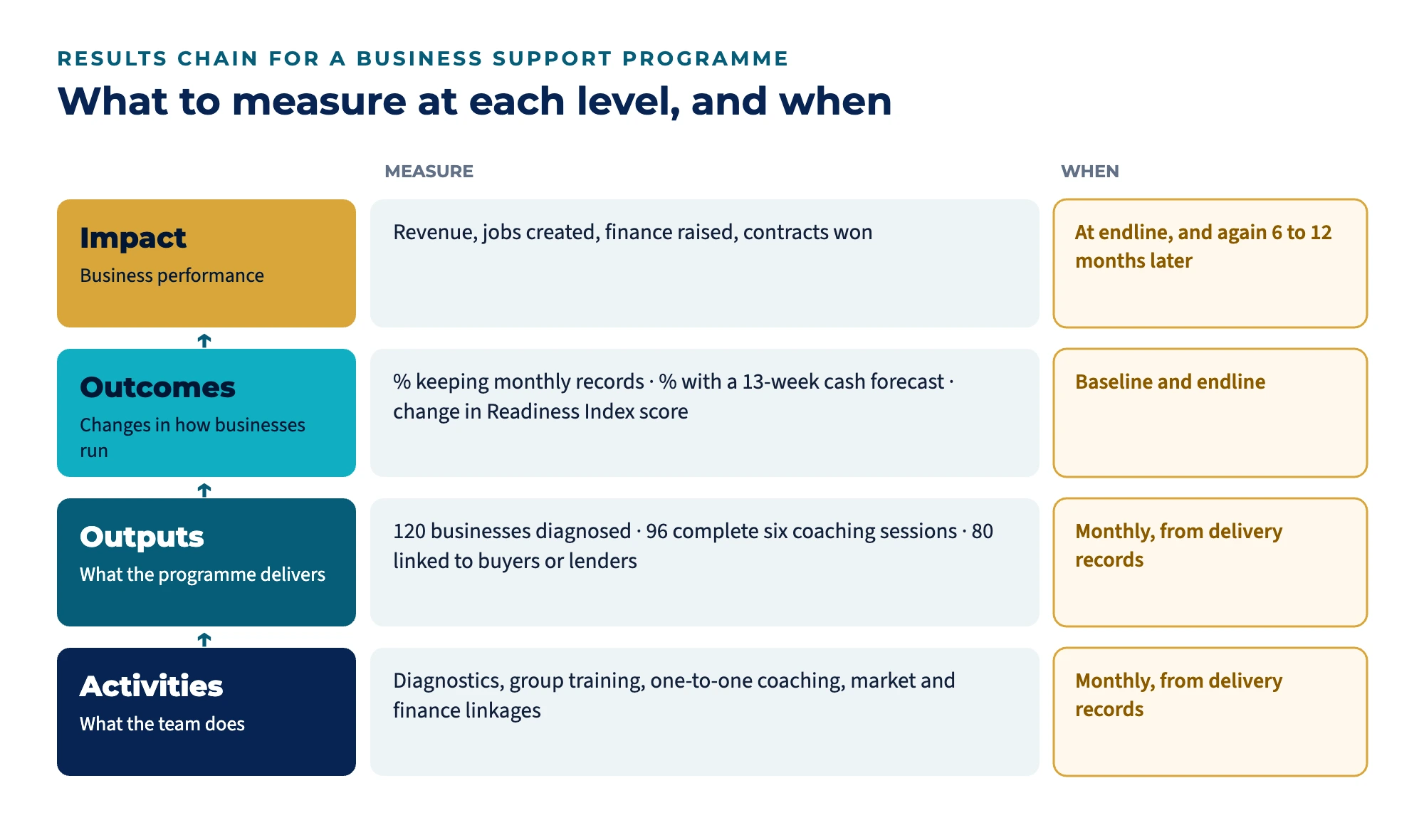
A results chain sets out how your support is expected to lead to better business performance. The Donor Committee for Enterprise Development uses results chains as the starting point of its Standard for Results Measurement for private sector development programmes, and it is a useful reference for any BDS provider. If you are writing a full results framework, our guides on how to write a theory of change and how to write a logframe show the method.
Activities and outputs: what you deliver
Count what the programme delivers: businesses diagnosed, training sessions attended, coaching sessions completed, and links made to buyers or lenders. These come from your own delivery records and should be updated every month.
Outcomes: how businesses run differently
This is the level most programmes skip when measuring results of business development services, and the one that tells you most. Has the owner started keeping monthly records? Separated business and personal money? Built a 13-week cash flow forecast? Registered as a supplier? Changes in practice appear within the life of a programme and point to later performance.
Impact: business performance
Revenue, profit, jobs, finance raised and contracts won. Measure them at endline, but plan a follow-up six to twelve months later, when much of the change actually shows.
Baseline and endline: compare like with like
A baseline is your starting picture of each business. The endline repeats exactly the same measures at the end. Four rules keep the comparison credible:
- Use the same tool, questions and scoring at both points. A changed question breaks the comparison.
- Collect the baseline before support starts, ideally at enrolment, so early coaching does not inflate it.
- Record who answered. The owner, not a staff member, should answer both times.
- Keep businesses that drop out in your records. Report how many finished, and compare the baseline of those who left with those who stayed.
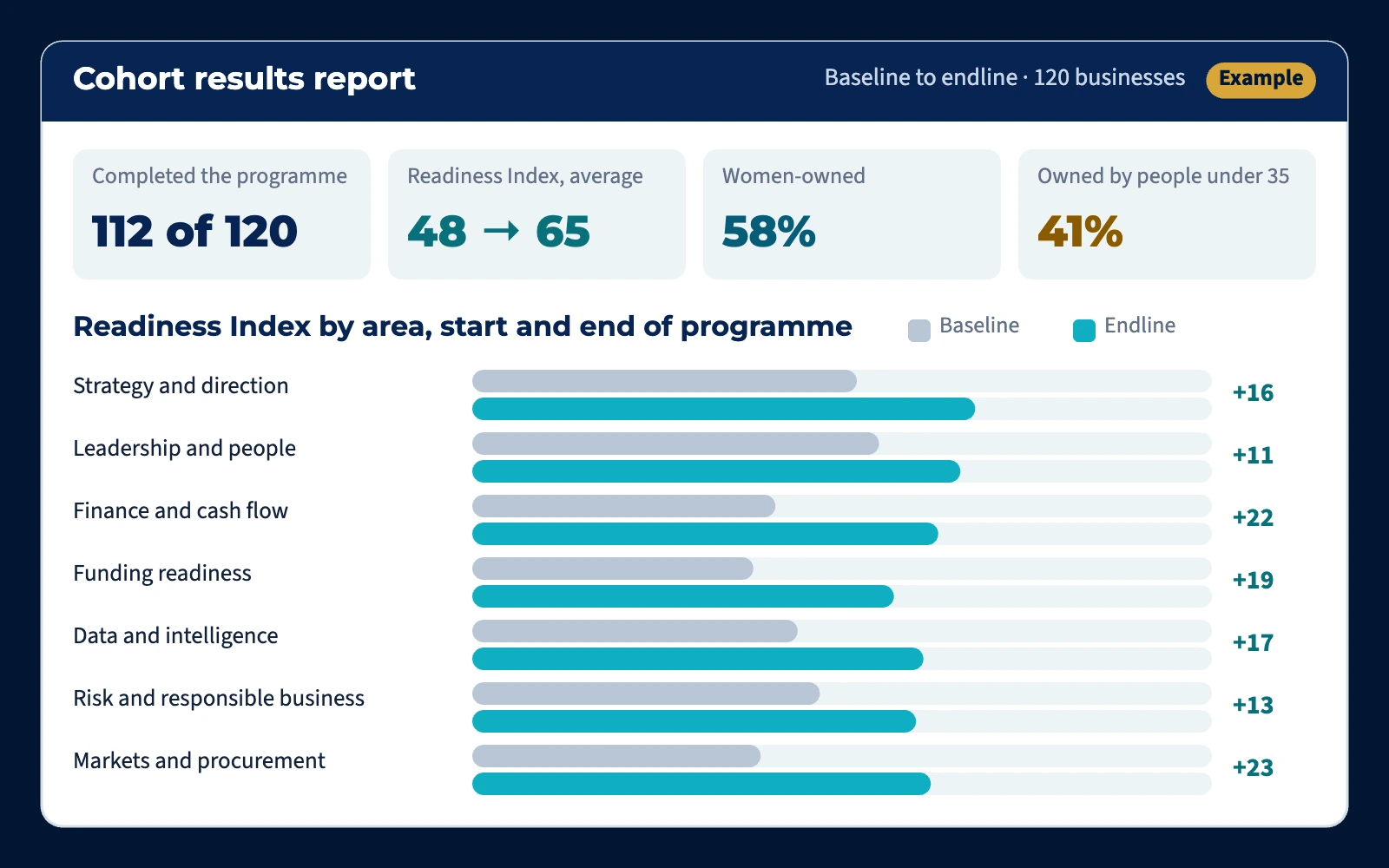
A structured diagnostic makes measuring results of business development services far easier. Centaora’s Strategic Readiness Index scores a business out of 100 across seven areas, including finance and cash flow, funding readiness, and markets and procurement. Used at enrolment and again at the end of a cohort, it gives every business the same yardstick and the programme a comparable score for each one. Our guide to the business readiness assessment explains what each area covers.
Make indicators specific
“Improved record-keeping” cannot be measured. “% of businesses that kept monthly sales and expense records for the last three months, checked against their books” can. Our guide to SMART indicators has more examples.
Break results down by sex, age and location
Funders increasingly ask whether a programme reaches and benefits women, young people and businesses outside the main towns. An average can hide a group that is being left behind. Plan these breakdowns from the start, because they depend on what you record at enrolment.
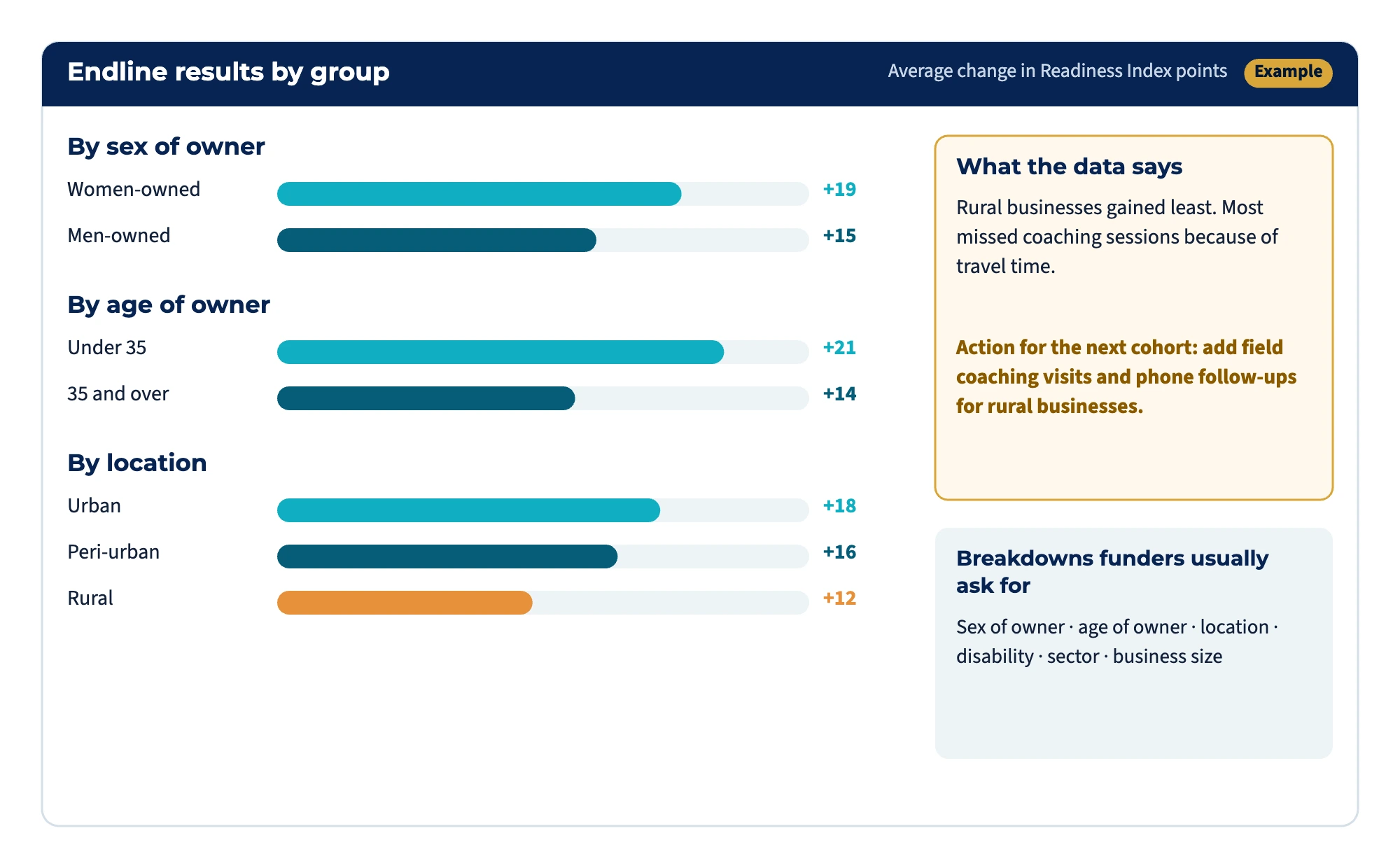
- Sex of the owner. Record who owns and controls the business, not only who attends. The international workshop agreement ISO IWA 34 sets out definitions of women-owned and women-led businesses that many programmes now use.
- Age of the owner. Use the definition your funder or country uses. The African Youth Charter defines youth as 15 to 35, while Kenya’s Constitution uses 18 to 34. State which one you applied.
- Location. Urban, peri-urban and rural at a minimum, and county or district if the programme spans several.
- Disability, sector and business size where they matter to the funder or to the programme’s goals.
Collect only what you will use, explain to owners why you are asking, and store personal data securely in line with your country’s data protection law.
Clusters and incubators: measuring groups as well as businesses
Some programmes support a whole cluster, such as dairy processors in one county or garment makers in one town. Others run incubator cohorts over several years. Both should add two things: measures for the group as a whole (shared buyers secured, joint purchasing, membership of a cluster association) and a simple cohort-by-cohort comparison, so you can see whether later cohorts do better as the programme improves.
Report results your funder can use
- Reach: how many businesses enrolled, finished and were followed up, with breakdowns.
- Change: average baseline and endline scores, and the share of businesses that improved.
- Performance: revenue, jobs and finance at endline and follow-up, with the number of businesses reporting.
- Learning: what worked, for whom, and what you will change next time.
- Proof of completion: certificates for participants who met the requirements, each verifiable online through Centaora Certify.
Programmes with several partners can track their indicators in one place with the Impact Dashboard, which shows progress against target each reporting period. See monitoring and evaluation made practical for how it works.
Common mistakes
- Counting attendance as results. Attendance is an output, not an outcome.
- Changing the diagnostic halfway through. Results from different tools cannot be compared.
- Reporting averages only, which hides who benefited least.
- No follow-up after the programme ends, so performance gains are never captured.
- Collecting data nobody analyses. Every question should feed a decision or a report.
Work with us on your next cohort
Measuring results of business development services is built into every cohort Centaora delivers for providers, incubators, and government and development-finance programmes, from diagnosis to the final report. Each business takes the Strategic Readiness Index at the start and end, receives group training and one-to-one coaching, plans its cash flow with an adviser and receives a verifiable certificate. The programme receives a cohort results report with the breakdowns its funder needs. Our cohort pilot is open to a small number of programmes.
Frequently asked questions
How do you measure the results of business development services?
Start with a results chain. Measuring results of business development services then means comparing changes in business practice and performance at baseline and endline with the same tool, break the results down by sex, age and location, and follow up six to twelve months later.
What is a baseline in an enterprise programme?
The starting picture of each business, collected at enrolment before support begins, using the same measures you will repeat at the end.
Which indicators should a BDS programme track?
A few at each level: delivery counts (outputs), practice changes such as record-keeping and cash planning (outcomes), and revenue, jobs and finance (impact).
When should results be measured after a programme ends?
At the end, and again six to twelve months later, when many performance changes first appear.
Run your next cohort with us
Diagnosis, coaching, certificates and a results report your funder can use, from one partner.