ESG used to be something only large listed companies reported on. That is changing fast. ESG requirements for SMEs are growing, not because new laws target small firms directly, but because the rules written for big companies travel along supply chains and into loan applications and funding proposals.
In 2026 and 2027, many small and mid-sized businesses, non-profits and suppliers will be asked about their environmental, social and governance practices for the first time, often by a customer or funder rather than a regulator. This guide explains what is changing around the world, why it reaches smaller organisations, and what to do in the next 90 days.
A global baseline for sustainability reporting
The International Sustainability Standards Board (ISSB) published two standards in 2023: IFRS S1 on general sustainability disclosures and IFRS S2 on climate. Countries decide whether and how to adopt them. By April 2026, 28 jurisdictions had adopted the standards on a voluntary or mandatory basis and 12 more planned to, according to S&P Global.
Adoption now spans every region. The UK issued its own versions in February 2026, and Australia, Hong Kong, Brazil, the Philippines, Nigeria and Kenya are among those that have adopted them. Most countries start with listed companies and banks, then widen to large private companies over the following years.
Why it reaches smaller organisations: IFRS S2 asks for Scope 3 emissions, the emissions in a company’s supply chain. A bank or manufacturer can only report these with data from its suppliers and borrowers.
Europe narrowed its rules, but the pressure moved down the chain
In early 2026 the EU’s Omnibus I package cut the scope of its main sustainability rules sharply (PwC, Travers Smith):
- Sustainability reporting (CSRD) now applies only to companies with more than 1,000 employees and over €450 million in turnover, including non-EU groups with that much EU turnover.
- Due diligence (CSDDD) now applies to companies with more than 5,000 employees and over €1.5 billion in turnover.
- The voluntary SME standard (VSME) is the recommended format for everyone else. It also caps what large companies may ask of smaller partners: requests should stay within what the VSME covers.
That cap matters. It makes ESG requirements for SMEs more predictable: a shorter, recognised set of questions, and businesses that prepare VSME-style information once can reuse it for many customers.
Two EU trade rules add to this for exporters. The Carbon Border Adjustment Mechanism entered its definitive phase on 1 January 2026, so EU importers of goods such as steel, aluminium, cement and fertiliser need real emissions data from producers. The EU Deforestation Regulation is scheduled to apply from 30 December 2026 for larger operators after a second delay, affecting coffee, cocoa, palm oil, soy, cattle, rubber and timber supply chains.
ESG requirements for SMEs now come through buyers
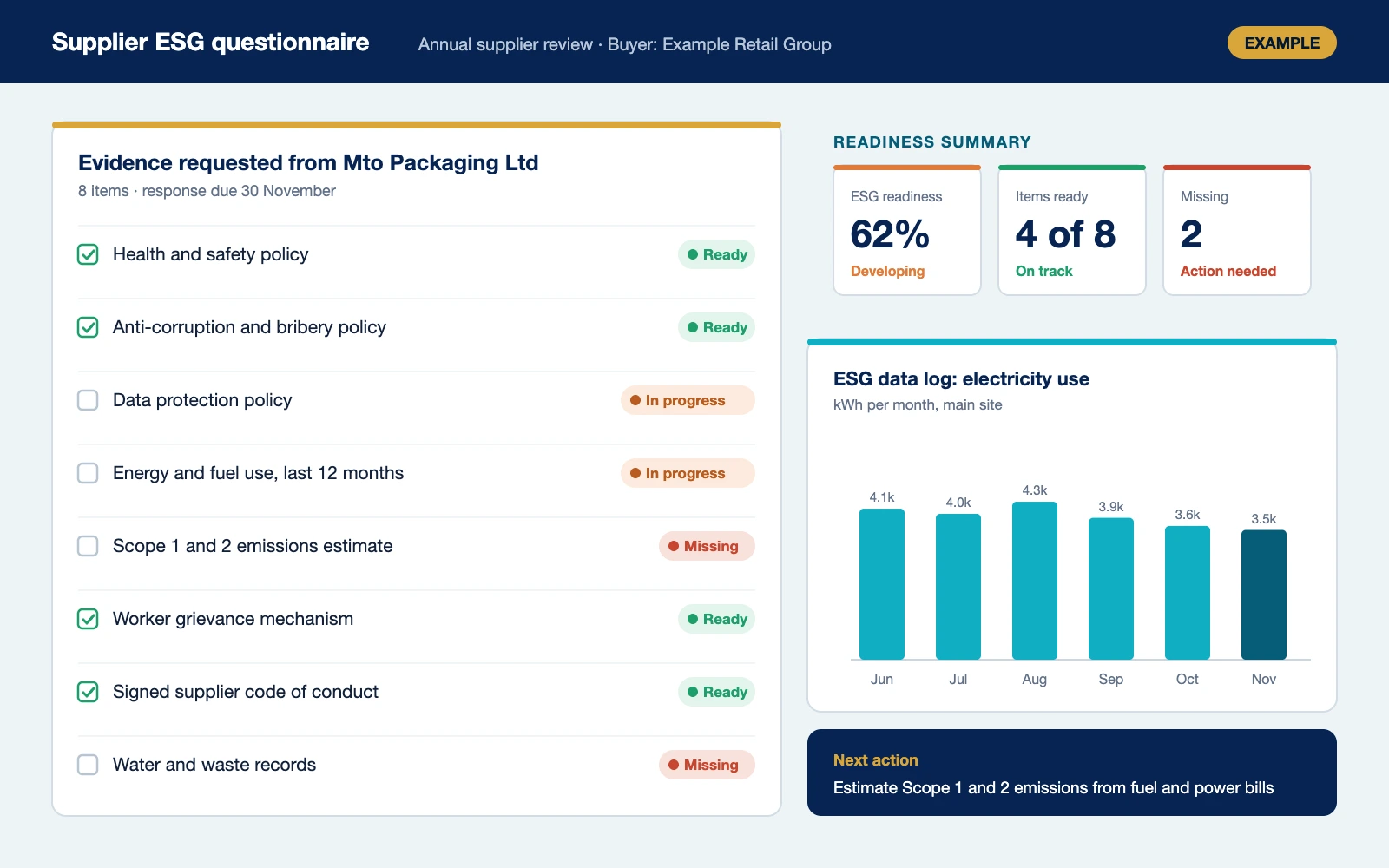
Up to two-thirds of a company’s ESG footprint can sit in its supply chain, according to the UN Global Compact. So large companies are adding ESG questions to supplier registration, tenders and annual reviews. Typical requests cover:
- energy and fuel use, and basic emissions estimates
- health and safety records and working conditions
- anti-corruption, data protection and supplier codes of conduct
- certificates or policies that back up the answers
Some buyers go further and train their suppliers. In Kenya, for example, I&M Bank and Global Compact Network Kenya run a supplier sustainability programme. Suppliers who can answer clearly and consistently stand out; those who cannot risk being dropped at the screening stage.
Lenders and funders want the same information
Banks that must report financed emissions under IFRS S2 need data from the businesses they lend to. Development finance institutions and impact investors have long required environmental and social management systems from the companies they back, usually built on the IFC Performance Standards. Donors increasingly ask non-profits for safeguarding, grievance and data protection arrangements.
The result: an organisation with basic ESG policies and data in place finds loan applications, due diligence and grant proposals faster and easier. That is why ESG requirements for SMEs now show up in loan, investment and grant applications as well as in tenders.
What ESG requirements for SMEs mean in practice
Most small and mid-sized organisations will never publish a sustainability report. But many will have to meet ESG requirements to keep customers, win contracts or secure finance. Three things follow:
- Proportionate is acceptable. Buyers expect a 40-person supplier to have clear policies and simple records, not a corporate report.
- Consistency matters more than polish. The same answers, backed by the same evidence, should go to every buyer and lender.
- Starting early is cheaper. Data takes a year to build. An organisation that starts recording energy use, incidents and staff figures now will have a full year of evidence when the questions arrive.
How to prepare in the next 90 days
- List who is asking. Note which customers, lenders and funders have sent ESG questions, or are likely to.
- Check where you stand. Compare what you already have (policies, records, certificates) with what they ask for. Our free Strategic Readiness Index is a quick starting point.
- Put the core policies in place. Health and safety, fair employment, anti-corruption, data protection and, where relevant, safeguarding and environment.
- Start a simple data log. Monthly energy and fuel use, water, waste, staff numbers and incidents.
- Name an owner. One person accountable for ESG answers, with leadership or the board kept informed.
- Prepare one set of answers. Reuse it across buyers and lenders, present it with the Capability Statement Builder, and update it every year.
How Centaora can help
Centaora’s consultants help businesses, non-profits and the programmes that support them meet ESG requirements for SMEs and larger organisations in proportion to their size, wherever they operate. We put the policies, data routines and governance in place, train teams and boards, and run readiness programmes for groups of suppliers. See our ESG readiness service or talk to an ESG consultant.
Frequently asked questions
Do small businesses have to report on ESG?
In most countries, not directly. Mandatory reporting covers listed and large companies. ESG requirements for SMEs arrive indirectly, through customers, lenders and funders who need their data.
What is the VSME standard?
A voluntary EU sustainability reporting standard for small and medium-sized enterprises. It gives smaller organisations a short, recognised format, and limits what large companies may request from them.
Is ESG only about climate?
No. Climate gets most attention, but buyers and funders ask just as often about working conditions, safety, safeguarding, anti-corruption and data protection.
Where should we start?
With the questions you are already being asked. Answer those well, with evidence, and build from there.