
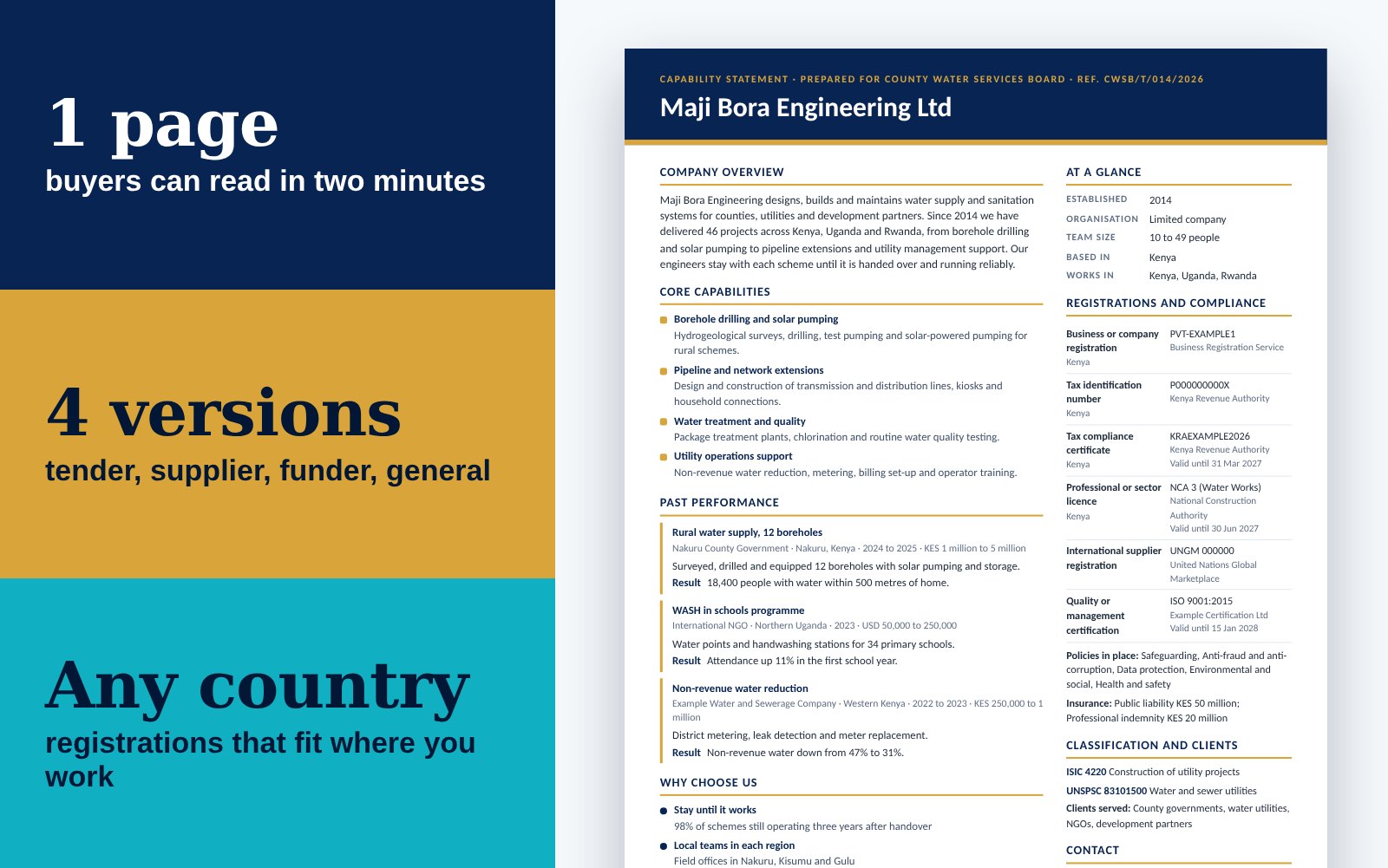
A capability statement is a one- or two-page summary of what your organisation does, who it has done it for and why a buyer or funder can trust it to deliver. Procurement officers, corporate supply teams and programme officers read dozens of them, often in a couple of minutes each. This guide explains what a capability statement should include, how to adapt it for tenders, suppliers and funders, and the mistakes that get one set aside. A free Capability Statement Builder is linked at the end.
What is a capability statement?
A capability statement is a short, structured document that presents an organisation’s core services, track record and credentials. It is used when registering as a supplier, responding to a tender or expression of interest, approaching a funder or development partner, or introducing your firm to a potential partner.
It is not a company profile. A company profile tells your story at length. A capability statement answers one question quickly: can this organisation do the work, and can it prove it?
What to include in a capability statement
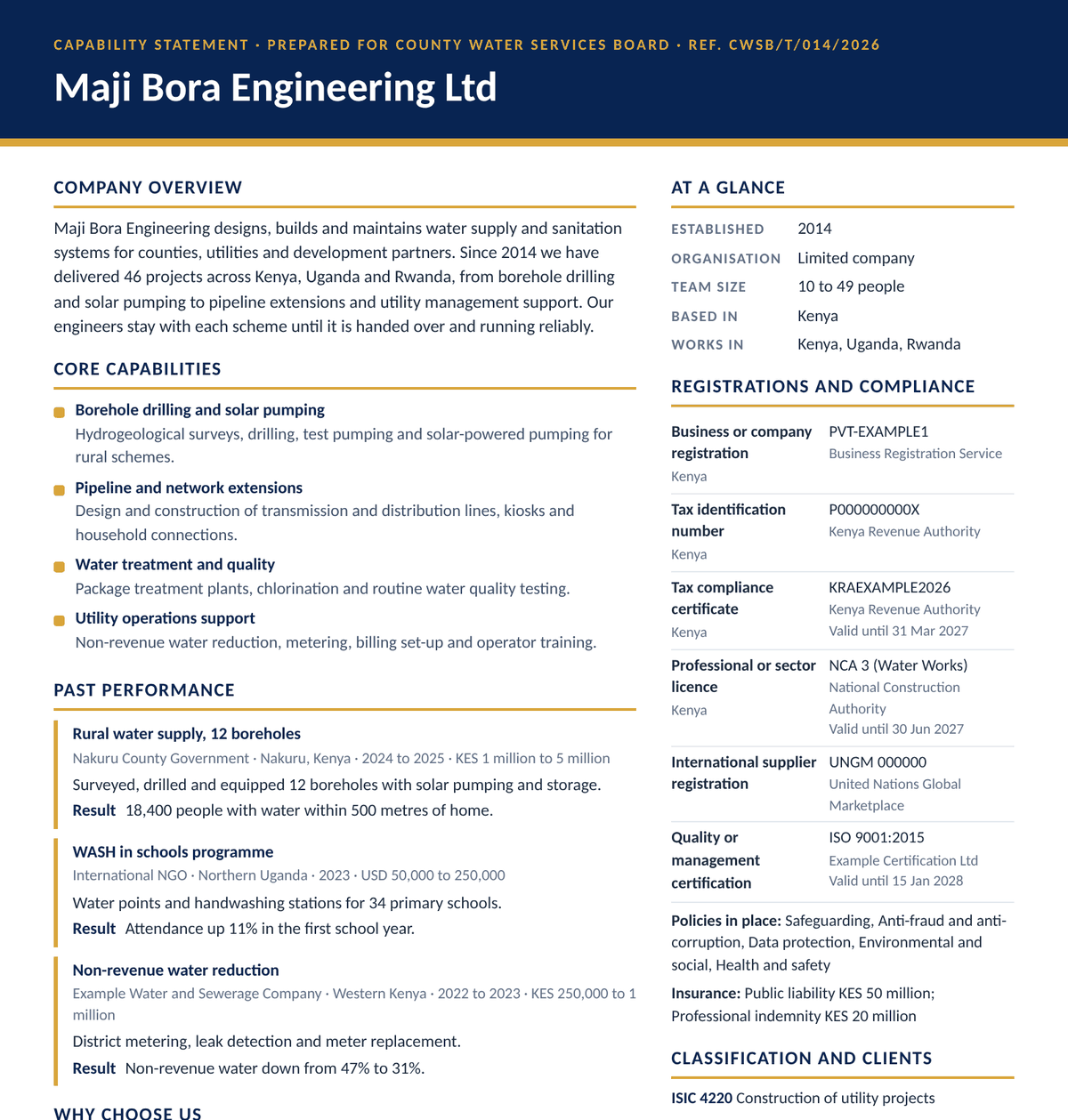
Most strong capability statements cover the same seven elements, in an order that suits the reader.
- Organisation overview. Two to four sentences on what you do, for whom and where, with one fact that proves experience, such as years in operation or projects delivered. Sixty to ninety words is usually enough.
- Core capabilities. Three to six services or products a buyer could contract you for, each with one line on what the client gets.
- Why choose us. Three to five specific strengths, each backed by evidence: a number, a location, a certification or a result.
- Past performance. Two to six relevant projects or contracts, with the client (or sector, if confidential), the year, the scope and above all the result.
- Registrations and compliance. Company registration, tax identification, supplier registrations, sector licences, quality certifications and the policies you have in place.
- Team. The key people who will do the work, or a short description of the expertise you draw on.
- Contact details. A named person, an email address and phone number, and your website.
Registrations: what to show, wherever you are
Buyers check registrations before they read anything else, but the names differ from country to country. Think in categories rather than local acronyms:
- Business or company registration: for example the Business Registration Service number in Kenya, Companies House in the United Kingdom or CIPC in South Africa.
- Tax identification and compliance: for example a KRA PIN and Tax Compliance Certificate in Kenya, a VAT number in Europe or an EIN in the United States.
- Government supplier or preference registration: for example AGPO in Kenya, the Central Supplier Database in South Africa or SAM in the United States.
- International supplier registration: the United Nations Global Marketplace (UNGM), World Bank or African Development Bank vendor registration, or a DUNS number.
- Licences and certifications: sector licences, professional body membership and ISO certificates.
Always show a validity date for anything that expires, and remove or renew anything that has lapsed. An expired certificate can disqualify a bid outright.
One statement, three audiences
The content stays the same; what leads changes with the reader.
- Tenders and public procurement: lead with compliance and capacity. Put registrations, classification codes and past contracts of similar size near the top.
- Corporate suppliers and partners: lead with what sets you apart, quality and service levels, then past clients in the same industry.
- Funders and development partners: lead with purpose and results. Show who benefited and what changed, then governance: safeguarding, anti-fraud and data protection policies.
Common mistakes that get a capability statement set aside
- Claims without proof. Words like “best”, “leading” or “world-class” are discounted by experienced readers. Use the fact that made you want to say it.
- Activities instead of results. “Trained 40 staff” is weaker than “Trained 40 staff; error rates fell by a third within six months.”
- Too long. If it runs past one page, cut the summary and keep only the most relevant projects. A second page is for tenders that ask for detail.
- No named contact. A general inbox gets fewer replies than a named person.
- One version for everyone. A funder and a procurement officer look for different things first.
Classification codes
Many procurement portals filter suppliers by industry code. ISIC is used worldwide, UNSPSC by the United Nations and many large buyers, NAICS in North America and NACE in Europe. Adding the two or three codes that match your main services helps buyers find you and shows you understand how procurement works.
Frequently asked questions
How long should a capability statement be?
One page is best. Use a second page only when a tender asks for more detail.
What is the difference between a capability statement and a company profile?
A company profile describes your whole business, often over several pages. A capability statement is short, tailored to one type of buyer, and focused on proof.
Should I include photos?
Only if they prove something, such as equipment or a completed project. Your logo and a clean layout matter more.
How often should I update it?
At least twice a year, after every significant contract, and whenever your registrations or certificates change.
Build yours with the Capability Statement Builder
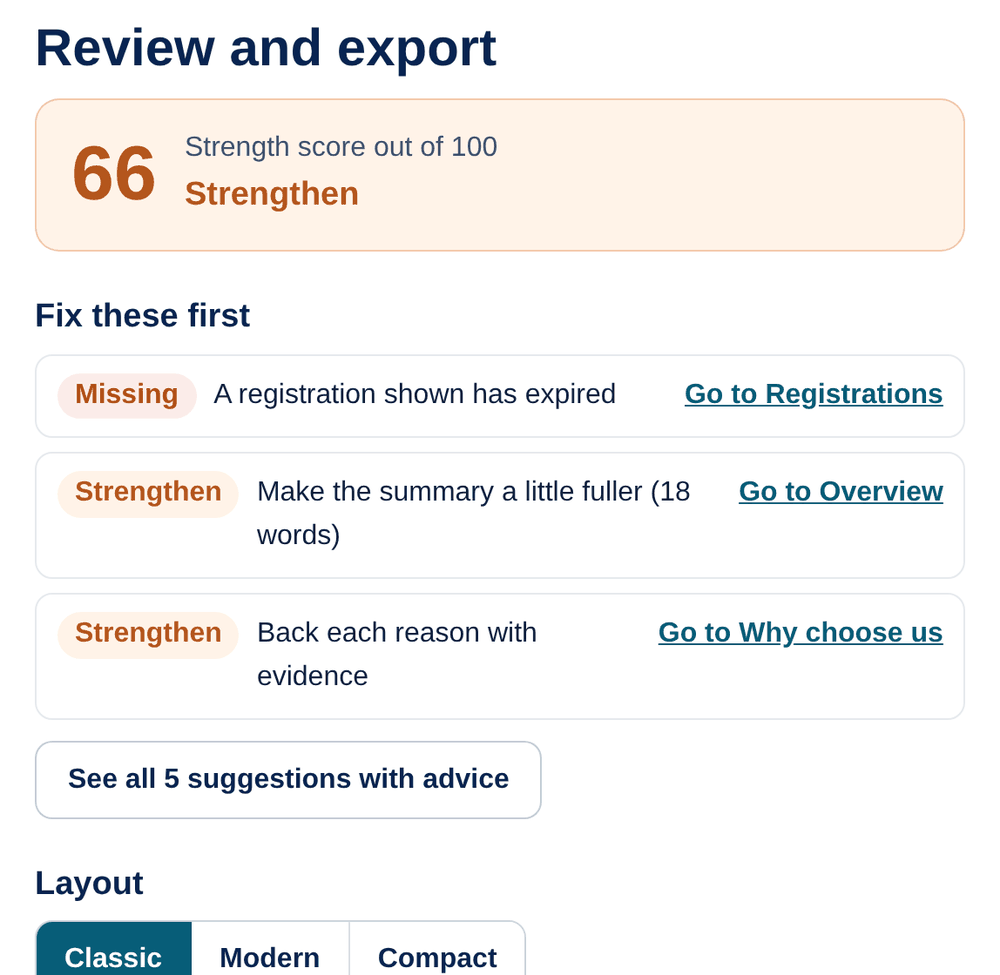
The Centaora Capability Statement Builder walks you through each section, adjusts the order for tenders, suppliers or funders, and works with registrations from any country. A strength check shows what is missing as you go, and the live preview shows exactly how the page will look. Starting is free; your statement stays in your own browser, and the final PDF, Word and share link are unlocked with Centaora credits.
Not sure your organisation is ready to bid yet? Start with the Strategic Readiness Index to see where you stand on procurement readiness, cash flow and governance.