
How organisations can turn priorities, evidence and capacity into purposeful action

Strategic thinking gives direction while strategic planning organises purposeful movement.
Many organisations have strategic plans. Fewer have created the habits, capabilities and decision-making processes required to remain strategic.
A plan may contain objectives, indicators, activities and budgets while leaving the most important questions unresolved: What has changed? Which opportunity should we pursue? What should we stop doing? Do we have the capacity to deliver what we have promised?
Understanding strategic thinking vs strategic planning helps organisations close the gap between ambition and action. Strategic thinking interprets the environment and makes choices; strategic planning converts those choices into coordinated commitments.
When the organisation has a plan but no real strategic choice
Some plans attempt to accommodate every department, stakeholder and existing programme. The result may be politically acceptable, but it is not necessarily strategic.
Strategy requires choice. In his influential critique of conventional planning, strategy adviser Roger Martin distinguishes strategy from the more comfortable exercise of developing plans. Strategy asks where an organisation will focus, how it will create value and why its chosen approach is more likely to succeed than the alternatives.
This is particularly difficult for public institutions and mission-led organisations. Declining an attractive opportunity, closing a familiar programme or concentrating resources on fewer priorities can feel inconsistent with an expansive mission.
Yet refusing to choose does not eliminate trade-offs. It simply allows limited resources, urgent requests and external pressures to make those choices indirectly.
If every objective remains a priority, the organisation has not made a strategic choice.
When activity is mistaken for progress
Organisations are often highly active without becoming more effective. Meetings are held, reports are submitted and projects are launched, but the desired institutional or societal outcome remains distant.
Strategic planning should establish a visible connection between activity and change. It should clarify the intended outcome, the assumptions behind the intervention, who owns the work and how progress will influence subsequent decisions.
This distinction matters because outputs are easier to count than outcomes. An organisation can report the number of people trained, consultations completed or tools developed without determining whether behaviour, capability or performance actually improved.
The question is not only, “Did we complete the activity?” It is, “What became possible because we completed it?”
When priorities multiply faster than capacity
One of the clearest signs of weak strategy is the continuous addition of priorities without the removal, postponement or redesign of existing work. Teams are expected to digitise services, develop partnerships, raise funds, respond to emergencies and maintain core operations using the same institutional capacity.
The problem is visible in resource allocation. A McKinsey survey of 617 executives and managers found that only about half believed their companies effectively aligned budgets with corporate strategy.
A priority that receives no meaningful allocation of money, time, skills or leadership attention remains an aspiration. Strategic planning becomes credible when it directs resources towards what strategic thinking has identified as most consequential.
Capacity also extends beyond staffing. It includes systems, data, institutional knowledge, trusted relationships, decision authority and the ability to coordinate across functions.
Capacity is not an operational detail added after strategy; it is one of the conditions that determines whether the strategy is real.

Strategy becomes credible when priorities are matched with resources and responsibility.
When evidence informs reports but not decisions
Many organisations collect more data than they use. Monitoring information moves upwards into dashboards, donor reports and board papers but does not always return to teams as a clearer decision.
Strategic thinking asks what the evidence means, which assumptions it challenges and whether the organisation should continue, adapt or stop. Strategic planning creates the review points through which that learning can affect implementation.
The World Economic Forum Future of Jobs Report 2025 found that seven in ten surveyed employers considered analytical thinking an essential core skill. The report drew on more than 1,000 employers representing over 14 million workers, suggesting that the ability to interpret information is becoming an organisation-wide capability rather than a specialised analytical function.
This requires more than producing evidence. People must be able to question its quality, recognise uncertainty, connect findings to context and explain what the information should change.
Evidence has strategic value only when it can challenge an assumption, improve a decision or change what happens next.
When people are expected to implement a strategy they did not shape
A strategy designed entirely at senior level may appear coherent while overlooking operational realities. The people responsible for implementation often understand constraints, relationships and emerging risks that are not visible in the boardroom.
Research on adaptive strategy in nonprofit organisations warns that even a compelling data strategy will fail without the infrastructure, expertise and processes needed to use the information. It also argues that execution improves when people across organisational levels understand the strategy and can apply judgement within their roles.
Involvement does not mean that everyone makes every decision. It means that relevant knowledge is brought into the process before choices become difficult to change, and that responsibility is matched with sufficient authority.
People support strategy more intelligently when they understand not only what was decided, but why the choice was made.
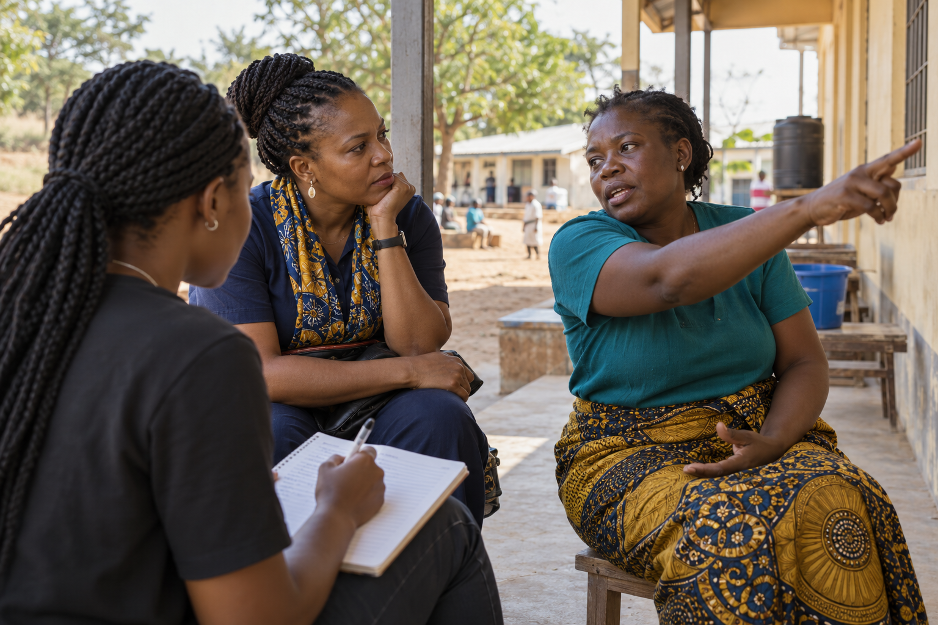
Implementation becomes more intelligent when operational knowledge can influence strategic choices.
When the annual plan meets a changing reality
Traditional planning often assumes that the environment will remain sufficiently stable for the plan to unfold. In reality, technology, funding, regulation, climate risks, stakeholder expectations and political conditions may change before the first annual review.
The OECD Strategic Foresight Toolkit encourages institutions to examine multiple plausible futures and stress-test policies against uncertainty. The objective is not to predict one correct future, but to make present decisions more resilient.
This is where strategic thinking vs strategic planning becomes an ongoing relationship. The plan provides direction and accountability, while strategic thinking keeps testing whether the direction still makes sense.
An organisation should be disciplined about its purpose without becoming rigid about the path.
Strategy also requires a culture of learning
An organisation cannot adapt if people are punished for questioning assumptions or reporting that an intervention is not working. Learning must be treated as a source of strategic intelligence rather than an admission of failure.
Microsoft offers a useful organisational example. Its 2024 Annual Report describes a culture grounded in growth mindset, continuous learning and operating as one company rather than as disconnected businesses.
The lesson is not that every organisation should imitate Microsoft. It is that strategy depends on the behaviour and capabilities of people, not simply on the quality of the document approved by leadership.
A future-ready organisation is not one that predicts every change; it is one that can recognise, interpret and respond to change without losing sight of its purpose.
Build a rhythm between thinking and planning
Organisations can bring strategic thinking and strategic planning together through a simple recurring review. Leadership teams, boards and programme teams can regularly ask:
- What has changed inside or around the organisation?
- What evidence or emerging signal deserves attention?
- Which assumption in our strategy needs to be tested?
- Do our resources reflect our stated priorities?
- What should we continue, adapt, stop, defer or delegate?
- What is the next strategic move, and who owns it?
- What are we learning that should influence the next decision?
These questions should not become another reporting template. Their purpose is to create an honest conversation about relevance, capacity, choices and progress.
The frequency should reflect the organisation’s context. A quarterly strategic review may be sufficient in a relatively stable environment, while rapidly changing programmes may require shorter learning cycles.

Strategy works as a cycle of observing, choosing, organising, acting and learning.
Strategy must remain alive relating strategic thinking vs strategic planning
Strategic thinking without planning can produce insight without coordinated movement. Strategic planning without strategic thinking can efficiently implement assumptions that no longer reflect reality.
Organisations need both. They need the imagination to see beyond current routines, the discipline to make choices, the capacity to act and the humility to learn from what happens next.
This is the deeper meaning of Centaora’s mission: Build capacity. Understand change. Create what matters. Capacity enables action, understanding keeps the organisation relevant and purposeful creation turns strategy into meaningful progress.
Centaora’s Insight
Strategy is not proven by the existence of a plan. It is revealed by the quality of an organisation’s choices, the capacity it builds and its willingness to learn when reality challenges its assumptions.
Continue exploring
Use seven strategic reflection questions to clarify what matters, test evidence and turn reflection into purposeful action.
Explore emerging signals and changing organisational realities through The Centaora Signal.
Discover more perspectives on strategy, capacity and future readiness in Centaora Insights. If your organisation needs support connecting strategic direction with the capacity to deliver it, start a conversation with Centaora.
Research sources
- Roger Martin, The Big Lie of Strategic Planning, Harvard Business Review
- World Economic Forum, Future of Jobs Report 2025
- McKinsey and Company, Resource Allocation for Long Term Value Creation
- OECD, Strategic Foresight Toolkit for Resilient Public Policy
- Stanford Social Innovation Review, How Adaptive Strategy Is Adapting
- Microsoft 2024 Annual Report