
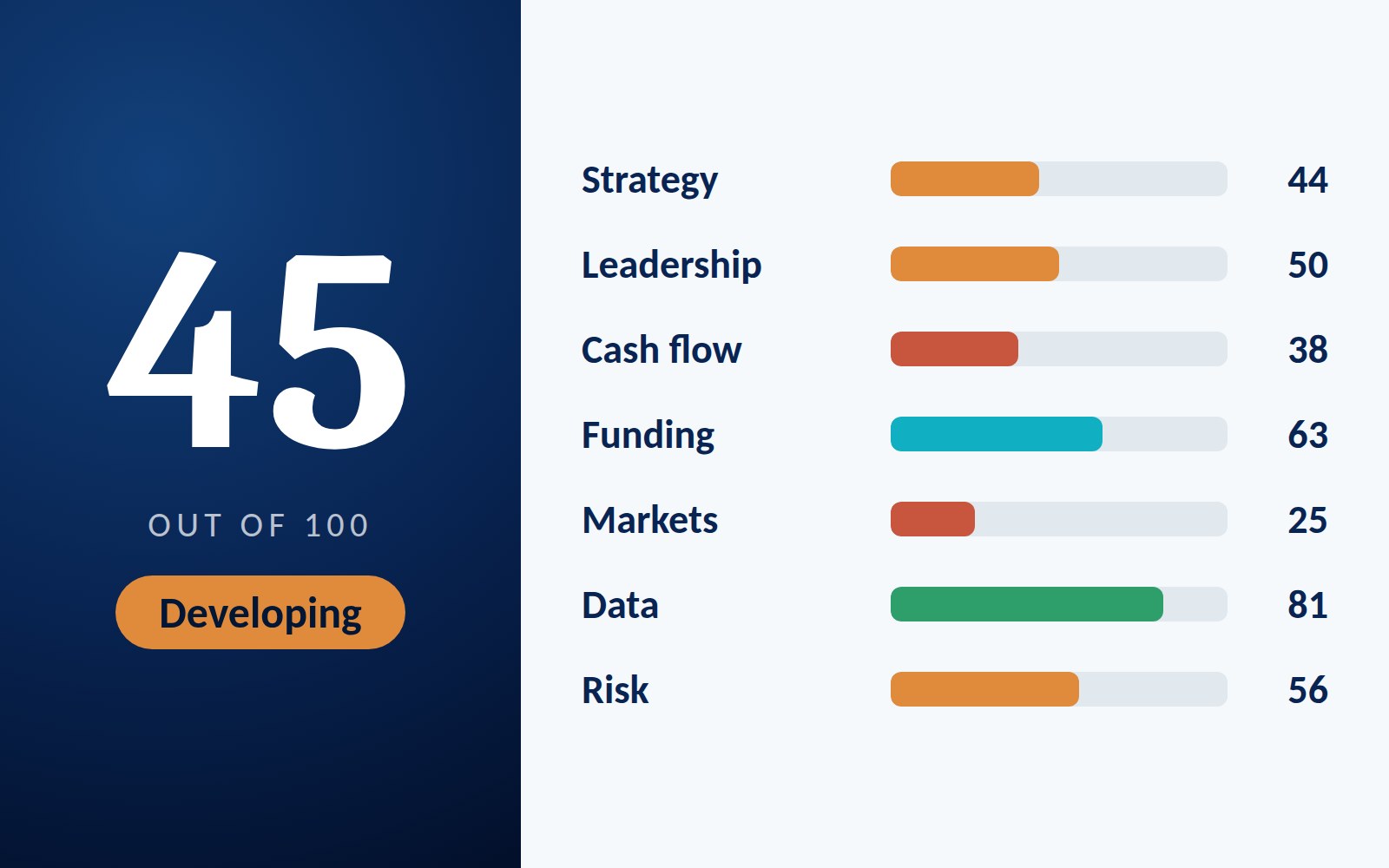
A business readiness assessment answers a question most owners only ask when something goes wrong: is this business ready to grow, to win a larger contract, or to survive a bad quarter? This guide explains what a business readiness assessment measures, why it matters, and how to turn the result into a 90-day plan. It also introduces the Strategic Readiness Index, a free assessment you can complete in about six minutes.
What is a business readiness assessment?
A business readiness assessment is a structured review of how a business is run today. It does not look at the product or the market. It looks at the practices underneath: whether there is a written strategy, whether the numbers arrive on time, whether the business could run without its founder, and whether it could show a funder or a buyer what they ask to see.
The result is usually a score, a picture of strengths and gaps, and a short list of priorities. Used well, it replaces a vague sense that “we should be more organised” with three or four specific things to fix first.
Why business readiness matters
Good businesses fail for ordinary reasons. Around one in five small businesses closes within its first year, and only about half are still trading after five years, according to figures cited by the World Economic Forum. The causes are rarely dramatic. Cash runs short, a key person leaves, a large customer pays late, or a loan application is turned down because the records are not there.
The evidence that management practices make the difference is strong. A study of more than 10,000 small firms in six countries, published by the International Labour Organization, found that everyday practices such as record-keeping, financial planning and marketing explained differences in sales, profits and survival, even after allowing for the owner’s education.
Readiness matters most where support is thinnest. The World Bank puts the financing gap for small businesses in emerging economies at 5.7 trillion US dollars. Women own an estimated 38 per cent of small and medium-sized businesses, yet win about one per cent of public procurement, according to the International Trade Centre. Owners without a board, a mentor or a banker have nobody to point out the gaps. An assessment can do part of that job.
The seven areas a business readiness assessment should cover
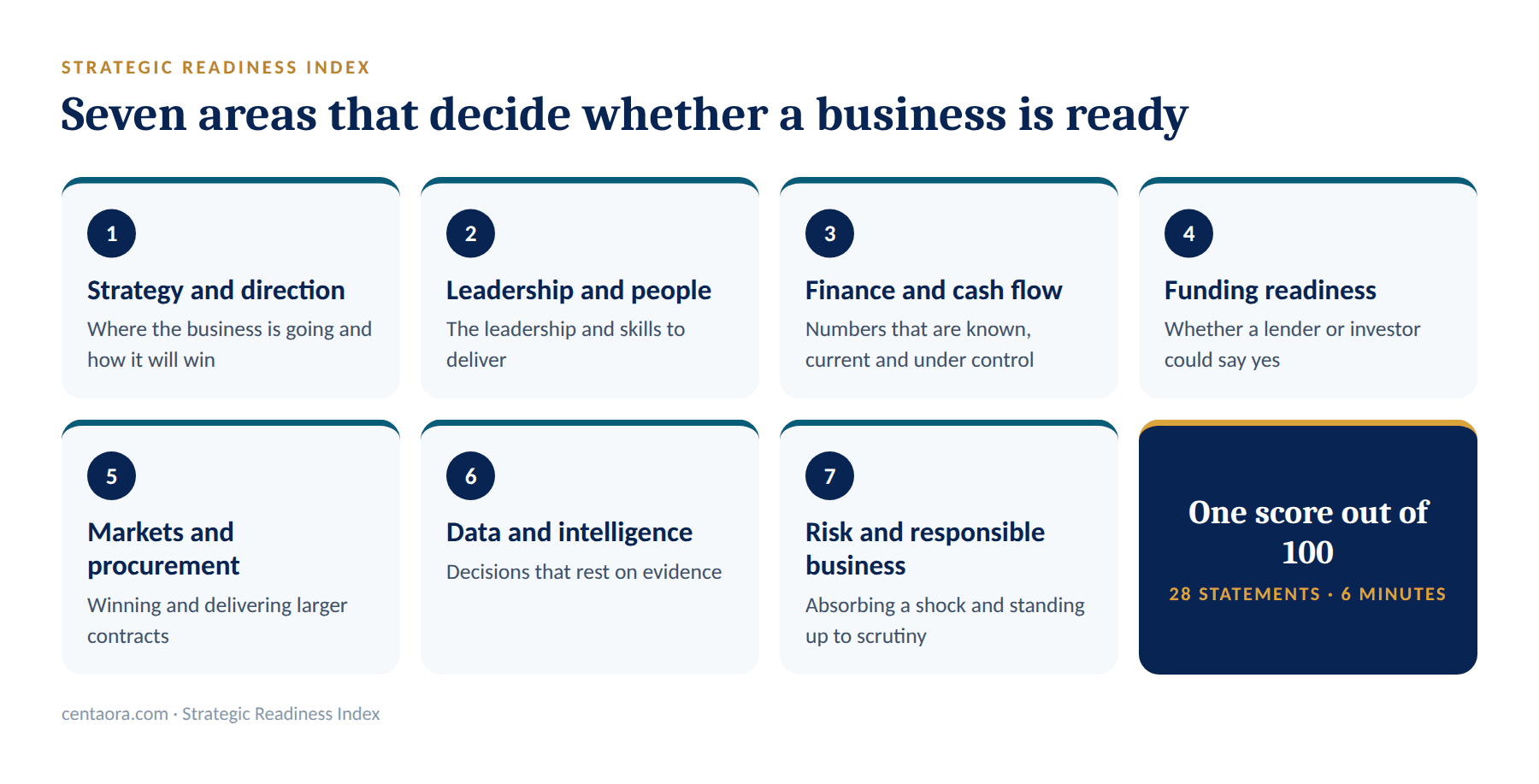
- Strategy and direction. A written strategy, a clear view of which customers and products earn the profit, and goals with numbers and owners.
- Leadership and people. Whether the business can run without its founder, whether roles are clear, and whether key people have cover.
- Finance and cash flow. Timely accounts, a cash forecast at least 13 weeks ahead, known margins and a routine for collecting payments.
- Funding readiness. Checked financial statements, current filings and licences, a business plan with projections, and documents ready to share.
- Markets and procurement. The registrations and certificates buyers ask for, a habit of tracking tenders, and proof of past work.
- Data and intelligence. A small set of measures reviewed every month, and decisions backed by evidence.
- Risk and responsible business. A list of the main risks, a tested continuity plan, and data that is backed up and handled lawfully.
How to assess your business readiness in four steps
- Answer for today, not for next year. Rate each practice as it is now. A plan to write a strategy is not a strategy.
- Use a simple scale. Five levels work well, from “not in place” to “fully in place and reviewed”. The last two words matter: a policy nobody has looked at in three years is not fully in place.
- Involve more than one person. Founders tend to score strategy high and finance staff tend to score it low. The difference is useful information.
- Look at the pattern, then the score. A business scoring 60 with one area at 25 has a different problem from a business scoring 60 evenly.
What the score means
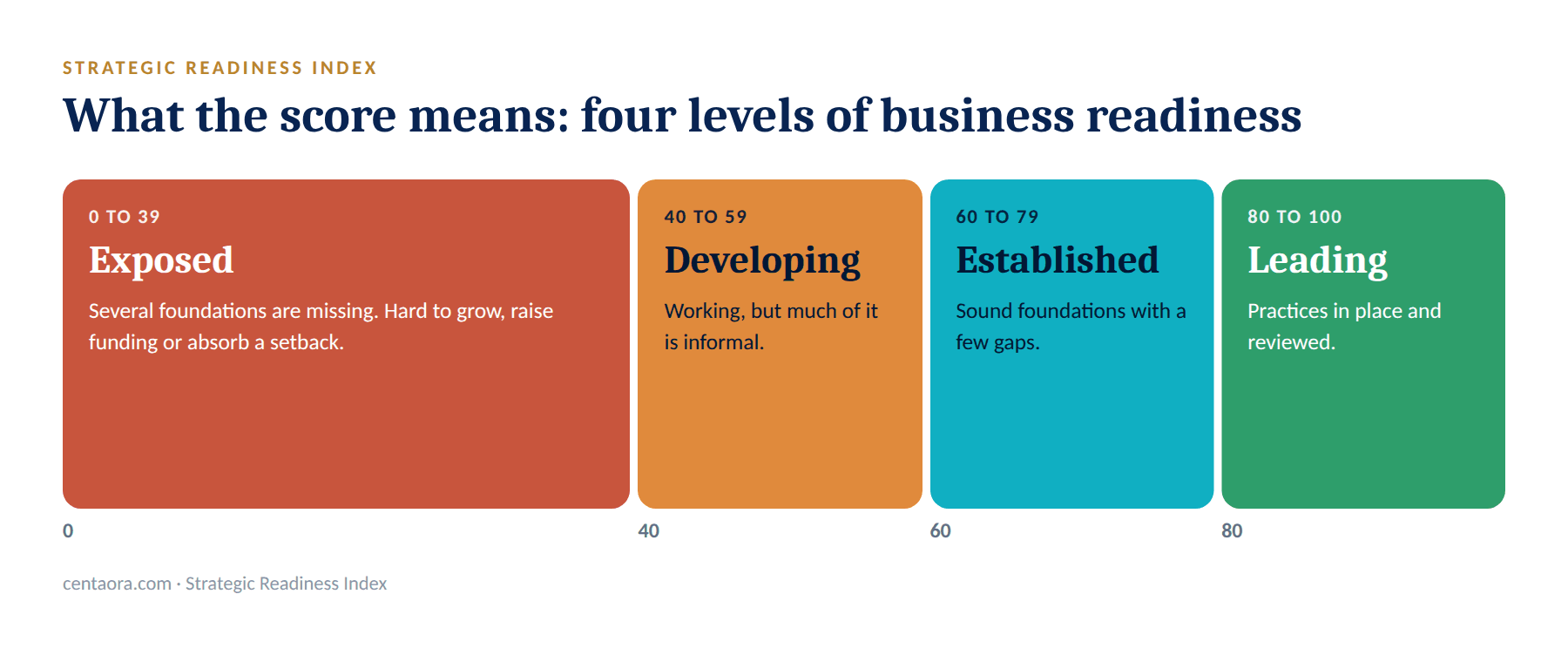
The Strategic Readiness Index places every business at one of four levels. Exposed means several foundations are missing. Developing means the business works, but informally. Established means the foundations are sound with a few gaps. Leading means practices are in place and reviewed. Most small businesses that take an assessment for the first time should expect to land in the first two levels, and that is the point: the score is a starting line.
From score to a 90-day action plan
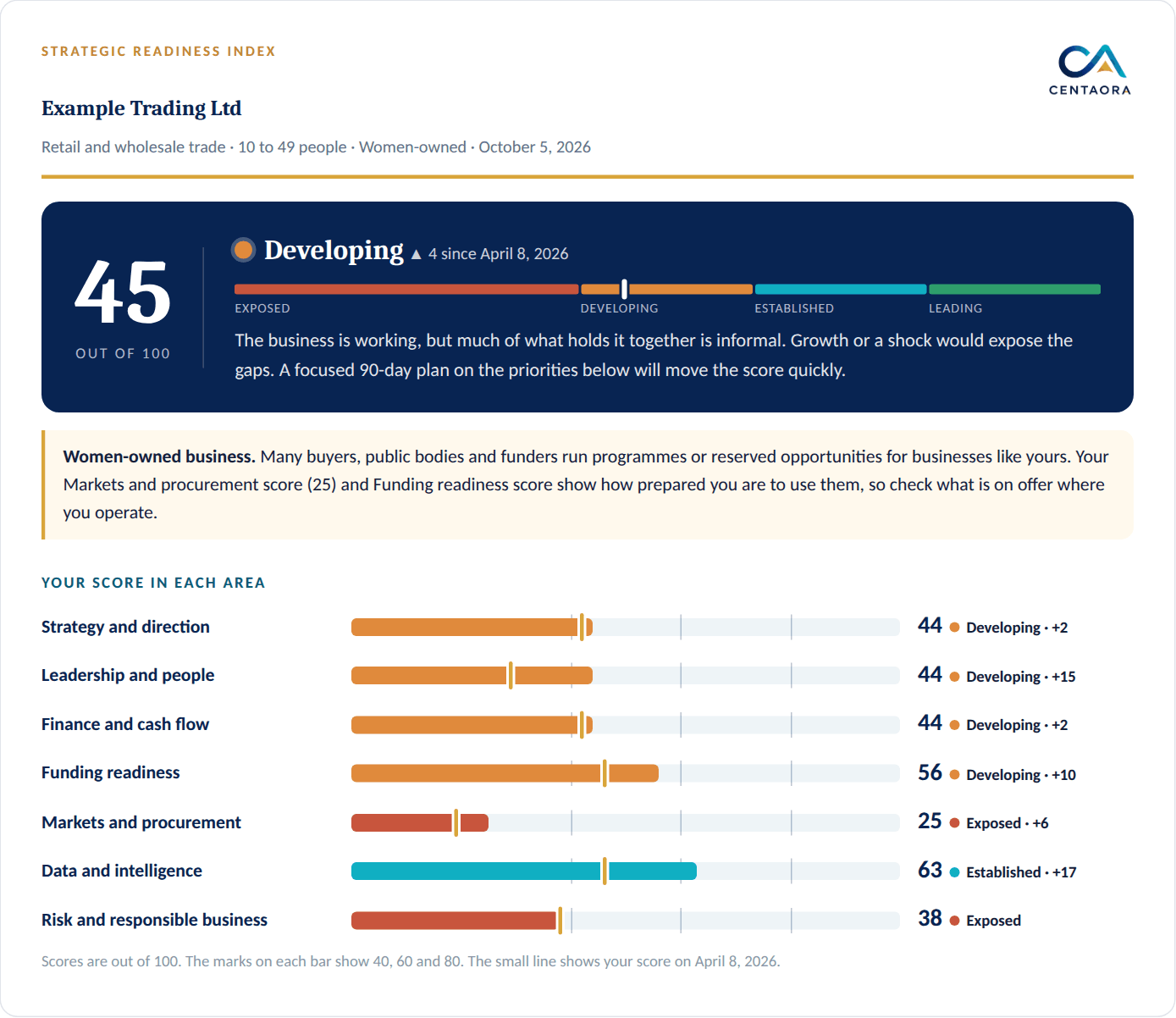
An assessment only helps if it changes what happens on Monday. The same research that links practices to survival also found that one-off training rarely sticks. What works is a short plan with named owners, followed by a second measurement.
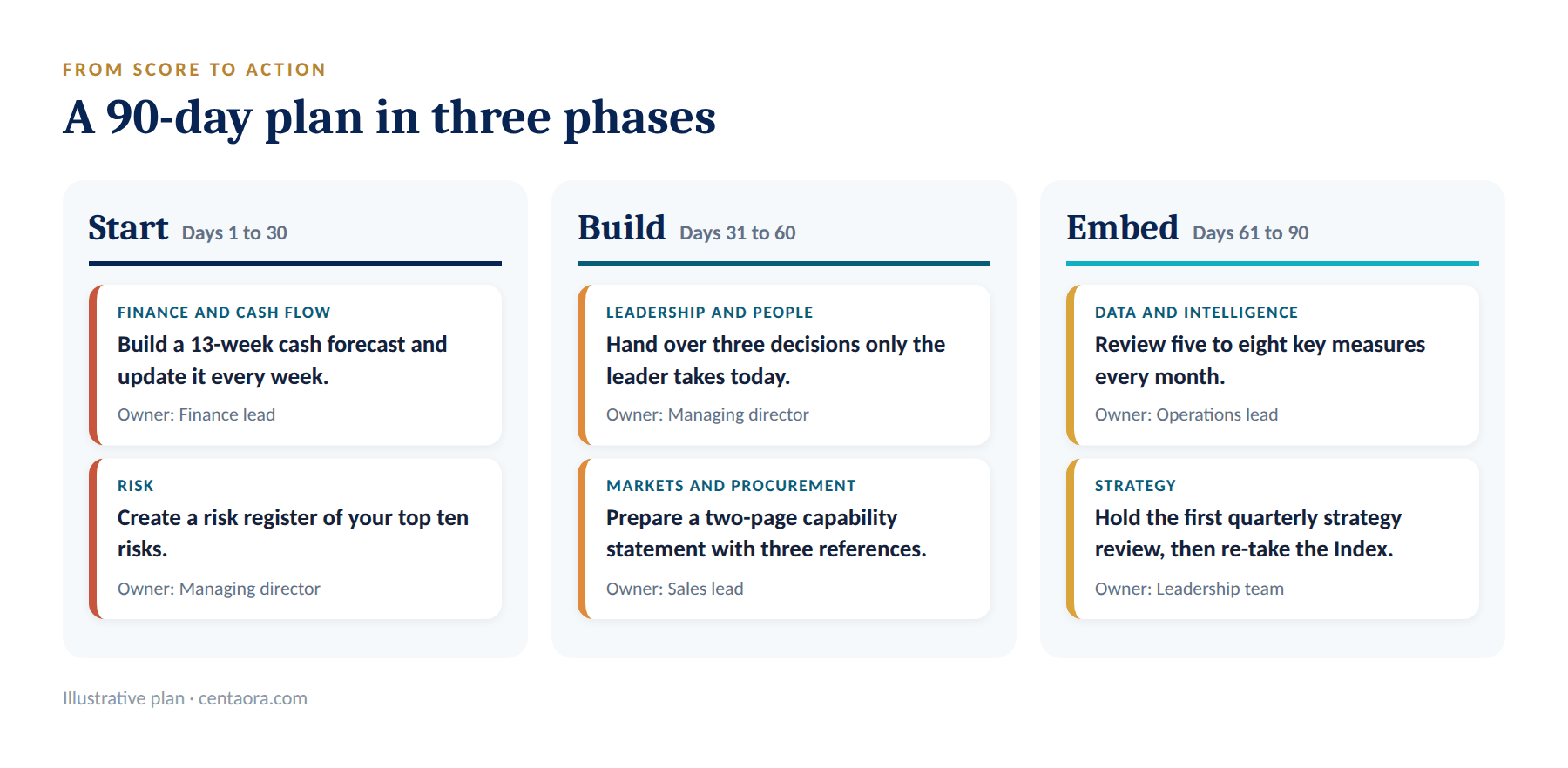
- Days 1 to 30, start. Fix the foundation items: the cash forecast, overdue filings, the risk list.
- Days 31 to 60, build. Put routines around them: a monthly review, a collections process, cover for key people.
- Days 61 to 90, embed. Review what has changed and take the assessment again.
Keep the plan to between five and eight actions. A short plan that is finished moves the score further than a long one that is started.
Try the Strategic Readiness Index
The Strategic Readiness Index is Centaora’s free business readiness assessment. You rate 28 statements across the seven areas above, one at a time. It gives you a score out of 100, a score for each area, your strengths, your biggest gaps and a 90-day plan you can edit, print or share. Your answers stay in your own browser.
Start the Strategic Readiness Index
Frequently asked questions
How long does a business readiness assessment take?
The Strategic Readiness Index takes about six minutes. A facilitated assessment with a leadership team usually takes half a day.
Who should complete it?
The owner or chief executive should complete it first. It is more useful when two or three senior people complete it separately and compare answers.
Is a business readiness assessment the same as an audit?
No. An audit checks evidence. A readiness assessment is a self-assessment based on your own answers. It is a guide to priorities, not a certificate, and not financial or legal advice.
Does it help with funding?
It does not provide funding. It shows whether you have what lenders and investors commonly ask for, and gives you a report you can show them.
How often should we repeat it?
Every three to six months while you are working on a plan, then once a year.
For more on the thinking behind strategy and readiness, see strategic thinking versus strategic planning, or explore what Centaora offers businesses.