
If you want to measure training effectiveness, the feedback form is the least useful place to start, even though it is the most common. Participants rate the venue, the lunch and the facilitator on the last afternoon, almost everyone gives four out of five, and nobody learns whether anything changed back at work.
Training providers, professional bodies and HR teams are increasingly asked to show more, especially as the skills that matter most keep shifting: that people learned, that they use what they learned, and that it made a difference. This guide sets out a practical way to measure training effectiveness without a research team.
The four levels of training evaluation
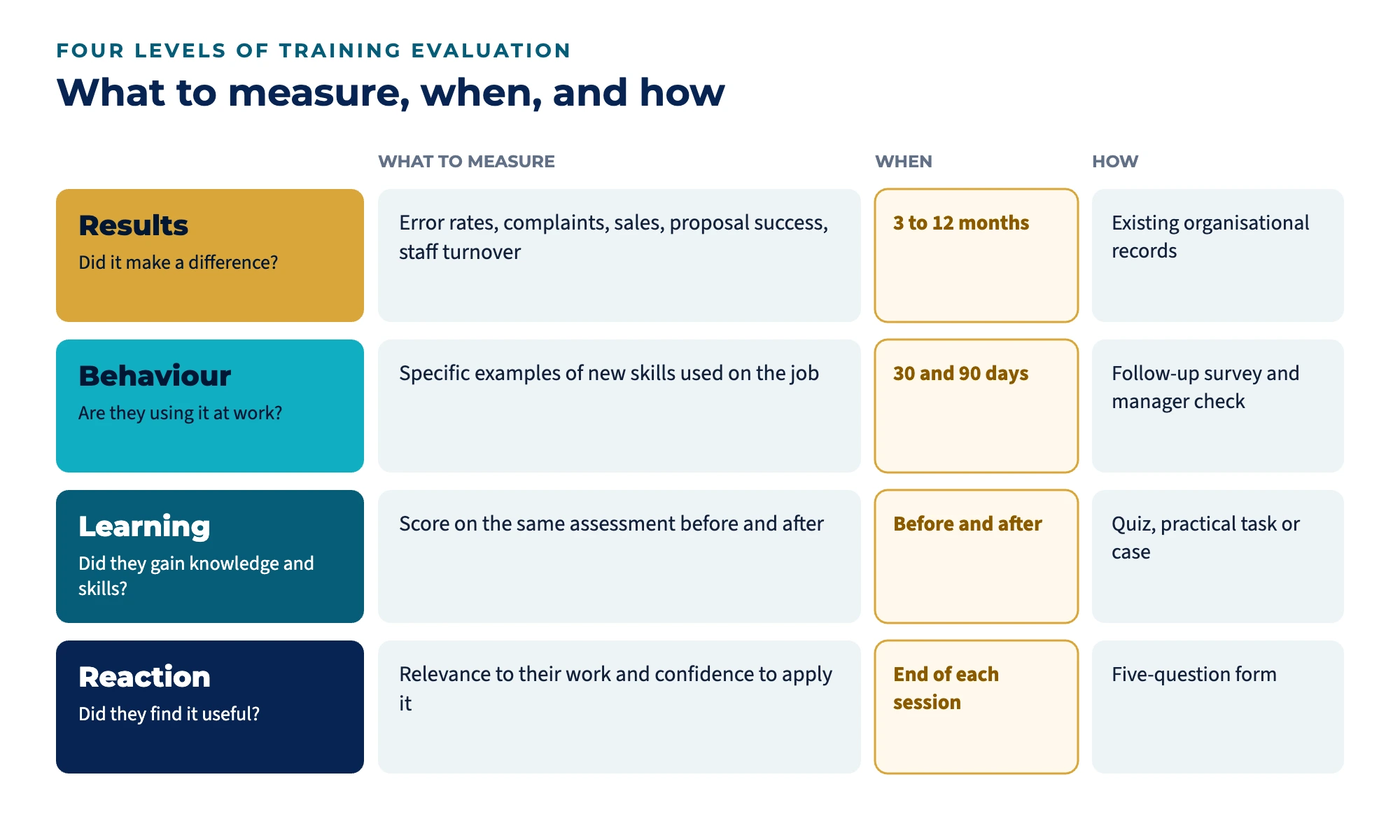
The best-known framework is the Kirkpatrick Model, first set out by Donald Kirkpatrick and now maintained by Kirkpatrick Partners. It looks at training at four levels: reaction, learning, behaviour and results.
Reaction: did participants find it useful?
The feedback form belongs here, but improve the questions. Ask how relevant the content was to their work and how confident they feel about applying it, not only whether they enjoyed it. Keep it short and collect it before people leave.
Learning: did they gain knowledge and skills?
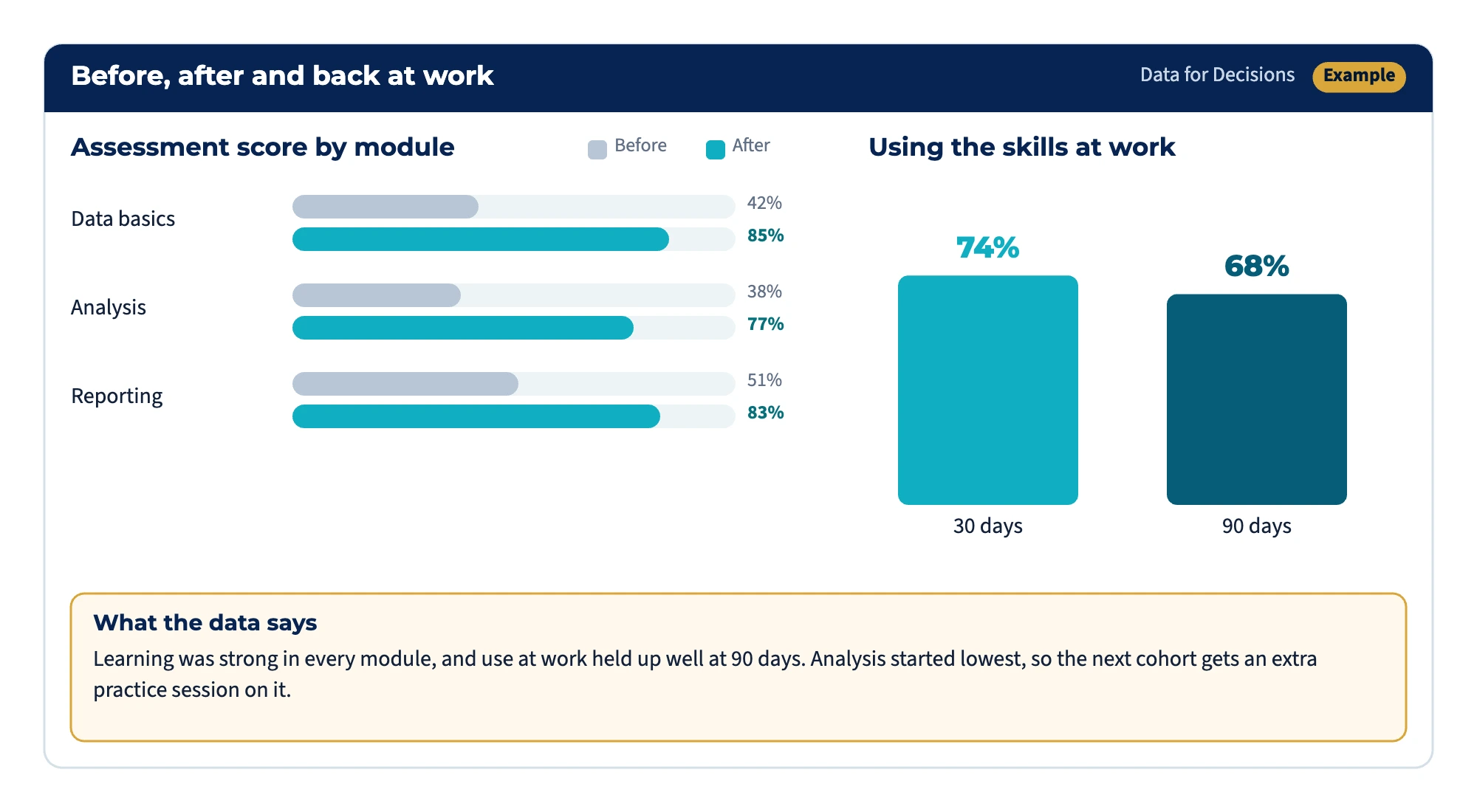
Use the same short assessment before and after the training: a quiz, a practical task or a case to solve. The difference between the two scores is your clearest evidence of learning. Assess what the course set out to teach, at the level it was taught.
Behaviour: are they using it at work?
This is where much training falls short, and where most evaluations stop looking. Follow up 30 to 90 days later with participants and, where possible, their managers. Ask for specific examples: a report written in the new format, a process changed, a tool now in use.
Results: did it make a difference?
Link the training to measures the organisation already tracks (our SMART indicators examples help you word them), such as error rates, customer complaints, sales, proposal success or staff turnover. Agree these with the sponsor before the training starts, so a baseline exists. Some evaluators add a fifth level, return on investment, associated with Jack Phillips, which compares the value of the results with the cost of the programme.
Start with the end in mind
The simplest way to measure training effectiveness is to agree what should change at work before you design the course. If you cannot name the behaviour you expect to see, you cannot measure it, and the course is probably too broad.
A practical plan to measure training effectiveness
| Level | What to measure | When | How |
|---|---|---|---|
| Reaction | Relevance and confidence to apply | End of each session | A five-question form |
| Learning | Knowledge and skill gained | Before and after | The same assessment twice |
| Behaviour | Use of new skills at work | 30 and 90 days | Follow-up survey, manager check, examples |
| Results | Organisational measures agreed in advance | 3 to 12 months | Existing records |
Make completion credible
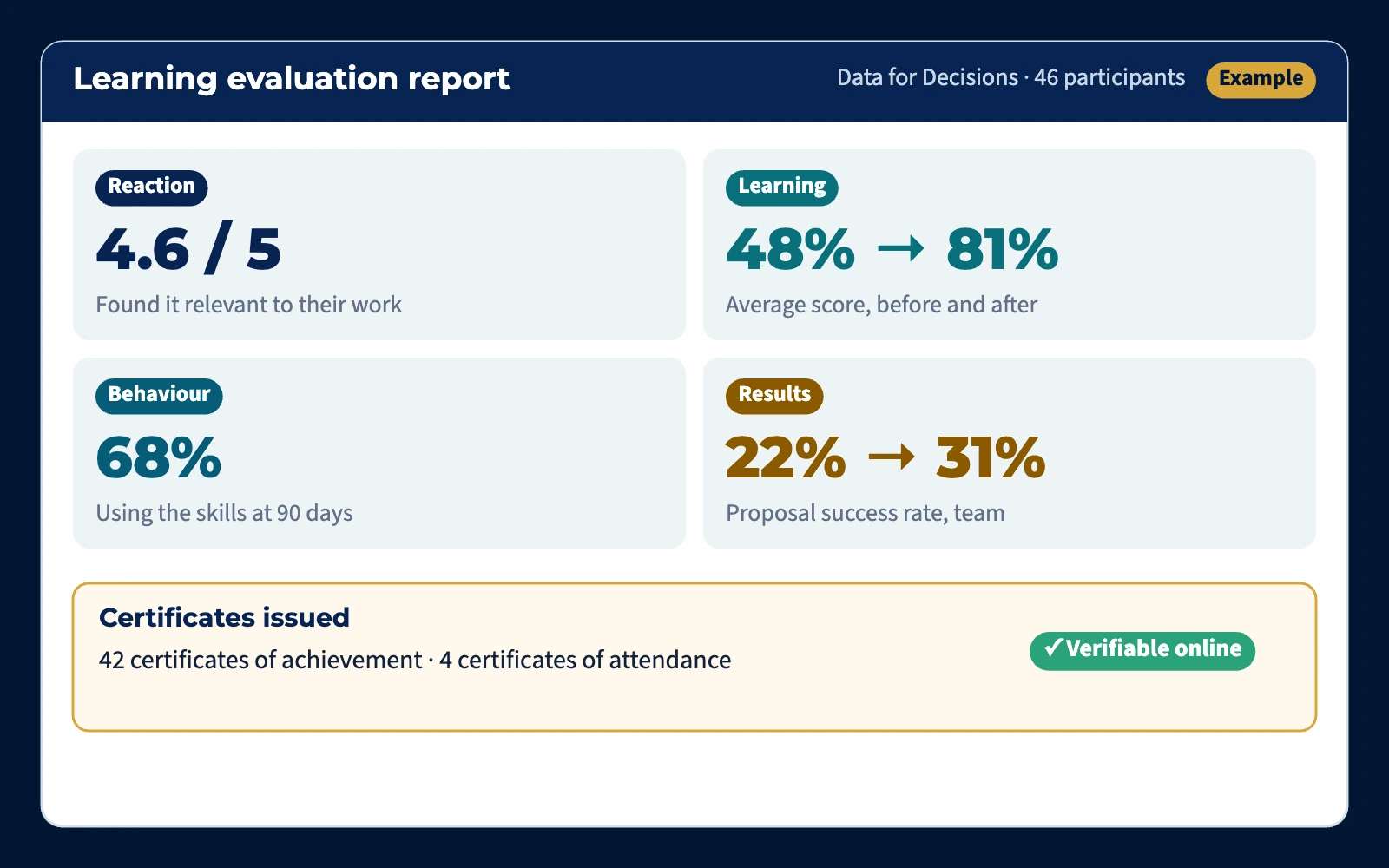
Completion is not the same as effectiveness, but it is the first thing employers and regulators check. Match the certificate to what was assessed: a certificate of attendance for presence, a certificate of completion for meeting the requirements, and a certificate of achievement where participants passed an assessment.
Paper and PDF certificates are easy to edit. Verifiable digital certificates carry a unique ID that anyone can check online, which protects both the learner and your reputation. Centaora Certify is a bulk certificate generator built for this: set up your template once, upload your participant list as a CSV with any extra fields you want on the certificate, such as hours or scores, and download the whole batch as PDFs, each with its own public verification record. See how to generate certificates in bulk with Certify, and why bulk certificate generation saves training teams hours after every course.
Common mistakes when you measure training effectiveness
- Relying on the feedback form alone. It measures satisfaction, not learning or change.
- Testing only at the end. Without a “before” score there is nothing to compare.
- No follow-up after the course, so nobody knows whether skills were used.
- Measuring everything. Choose a few measures that matter to the sponsor and collect them well.
- Reporting without learning. Use the results to improve the next run of the programme.
How Centaora can help
We work with training providers, professional bodies and universities on programmes people value. Our learning evaluation service helps you measure training effectiveness through pre- and post-assessment, follow-up with participants and employers, and learning and completion reports. We also design curricula, train trainers, and run AI, digital and leadership programmes. Our Centaora Certify pilot is open to a small number of institutions; see training and learning institutions.
Frequently asked questions
How do you measure training effectiveness?
To measure training effectiveness, plan before the training starts and look at four levels: reaction at the end of each session, learning with the same assessment before and after, behaviour through follow-up at 30 and 90 days, and results through measures the organisation already tracks.
What is the Kirkpatrick Model?
A widely used framework that evaluates training at four levels: reaction, learning, behaviour and results.
Is a feedback form enough to evaluate training?
No. A feedback form shows whether participants were satisfied. It does not show whether they learned, use the skills at work or whether results improved.
Why use verifiable digital certificates?
Each certificate has a unique ID that anyone can check online, so employers can confirm it is genuine without contacting you, and edited or fake copies are easy to spot.
Show what your training achieves
Learning evaluation and verifiable certificates for your programmes.