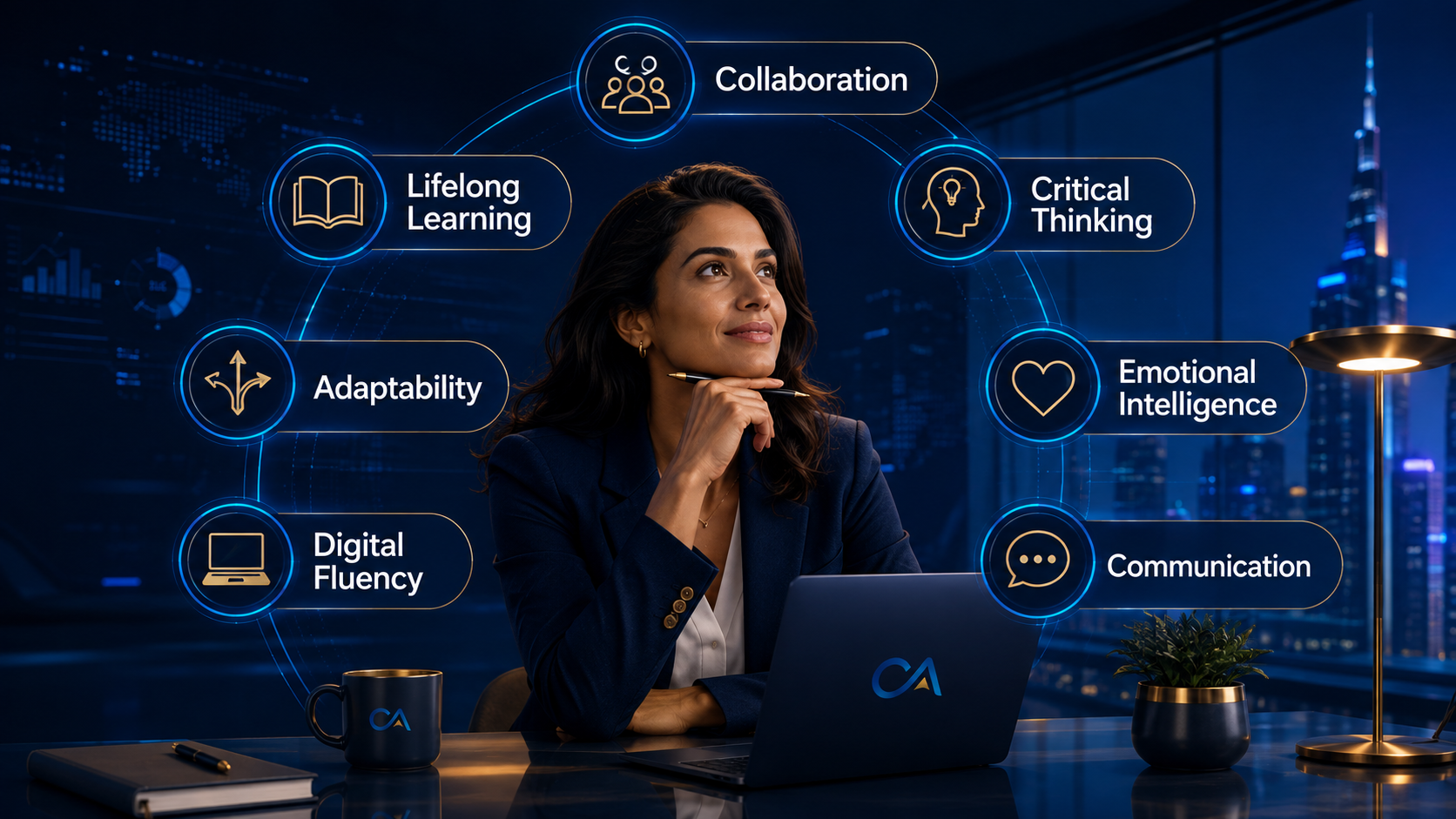
The strongest advantage over the next five years will not come from collecting more skills. It will come from building the right combination of human judgement, adaptability, technological fluency and the capacity to keep learning.

The question sounds simple: which skills should you build now to remain valuable over the next five years? Yet the answer is more complicated than choosing the latest technology course or adding another qualification to your CV. Let’s us take some time to explore the skills that will matter most in the next five years.
Work is changing quickly, but not in only one direction. Artificial intelligence, demographic change, economic uncertainty, the green transition and shifting business models are changing both what organisations need and how people create value.
The World Economic Forum estimates that 39% of the core skills required in the labour market will change by 2030. That does not mean that everything you know becomes obsolete; it means that the combination of capabilities needed to remain effective is being rearranged. Explore the Future of Jobs Report 2025.
The next five years are unlikely to reward people who simply collect more skills. They are more likely to reward people who understand which capabilities reinforce one another, which are becoming easier to automate and which help them respond intelligently when the environment changes.
The future is not asking us to choose between human and technical skills
Much of the conversation about the future of work is framed as a competition between people and technology. That framing is becoming increasingly unhelpful because the strongest professionals will probably need both.
AI and big data are among the fastest-growing skill areas, alongside networks, cybersecurity and technological literacy. At the same time, employers continue to place high value on analytical thinking, resilience, flexibility, creative thinking, leadership and curiosity.
The emerging advantage is therefore not human or technology; it is the ability to combine the two well. A professional who understands AI but lacks judgement can make poor decisions faster, while a thoughtful professional who refuses to engage with changing technology may eventually find that expertise alone is no longer enough.
Analytical thinking will become more valuable, not less
When information becomes abundant, the ability to access information becomes less distinctive. The more valuable capability is knowing what to trust, what matters and what conclusion the evidence actually supports.
Analytical thinking remains the most highly rated core skill in the World Economic Forum’s 2025 employer survey. This matters because AI may increase the amount of analysis available to us without necessarily improving the quality of the decisions we make from it.
Strong analytical thinking involves more than working with numbers. It means breaking a difficult problem into parts, identifying assumptions, recognising patterns, weighing evidence and asking whether the obvious explanation is actually the right one.
How to strengthen analytical thinking
Do not only consume information; interrogate it. When you read a report, proposal or AI-generated analysis, practise identifying the claim, the evidence behind it, the assumptions being made and what alternative explanation might also fit.
You can also strengthen analytical thinking by deliberately working on unfamiliar problems. Capability grows when the mind has to connect evidence rather than simply repeat what it already knows.
AI literacy will become basic professional literacy
There was a time when digital literacy meant knowing how to use email, spreadsheets and presentation software. AI literacy is rapidly moving toward the same category of foundational professional capability.
This does not mean everyone must become a machine-learning engineer. It means understanding what AI can do, where it can add value, how to work with it effectively and where human verification remains essential.
The ILO estimates that one in four workers globally is in an occupation with some degree of exposure to generative AI. Its analysis suggests that transformation rather than outright replacement is the more likely outcome for most exposed jobs because human input remains necessary. Read the ILO Generative AI and Jobs 2025 update
That shifts the useful question from whether AI will take a job to which parts of a role AI can strengthen and where human judgement becomes even more important. Professionals who learn to use AI thoughtfully may gain time, improve synthesis and explore ideas more quickly without outsourcing the thinking that makes them valuable.
The useful AI skill is not prompting alone
Prompting matters, but it is only one layer. A more complete AI capability includes framing problems, selecting appropriate tools, assessing output quality, protecting sensitive information, recognising hallucinations and integrating AI into a real workflow.
As AI systems increasingly work alongside people, the professional skill may shift from simply using AI to directing, evaluating and coordinating intelligent systems. Microsoft’s 2025 Work Trend Index, for example, anticipates growing use of human-agent teams and increased responsibility for managing AI-enabled workflows. Explore Microsoft’s 2025 Work Trend Index
Judgement will become a premium capability
Technology can generate options, but judgement decides which option deserves action. That distinction will become increasingly important because many professional tasks contain context that cannot be reduced easily to data.
A technically correct answer can still be a poor decision. Good judgement means understanding when evidence is sufficient, when more information is needed, which risks matter and what trade-offs are acceptable.
This is one reason experience will not suddenly become irrelevant in an AI-enabled world. Experience becomes especially valuable when it has been converted into judgement rather than simply years served.
Adaptability will matter more than having a perfect plan
Many people imagine adaptability as constantly changing direction, but useful adaptability is different. It is the ability to maintain effectiveness when circumstances change while adjusting methods without losing a meaningful sense of direction.
The World Economic Forum identifies resilience, flexibility and agility among the skills expected to grow in importance toward 2030. That matters to anyone making a career plan today because a five-year plan is only useful if it can survive an unpredictable future.
At Centaora, we think about this as the difference between having a fixed route and having a clear direction with adaptive capacity. The second is usually more useful because it allows change without turning every disruption into a loss of identity.
Curiosity and lifelong learning will become career infrastructure
For much of professional life, education has been treated as something that happens before work: you study first, then you work. That sequence is increasingly outdated as skill requirements evolve more quickly than a single qualification can cover.
The OECD Skills Outlook 2025 argues that rapidly changing skill needs make lifelong learning and timely labour-market intelligence increasingly important. People need ways to continue developing capability throughout their working lives rather than relying only on qualifications earned earlier. Read the OECD Skills Outlook 2025
Curiosity is what keeps that process alive because a curious person notices what is changing, asks better questions and remains willing to become a beginner again. Learning therefore becomes stronger when it is treated as a system rather than an emergency response.
Communication will remain essential because clarity will become scarcer
AI can already produce polished emails, reports, summaries and presentations, but this does not make communication less important. It may make real communication more important because producing grammatically correct words is not the same as helping another person genuinely understand an idea.
Effective communication requires understanding the audience, identifying what matters to them and choosing what deserves emphasis. In an environment overflowing with content, the professional who can explain complexity clearly and communicate uncertainty without creating confusion will continue to have an advantage.
Future communication will also increasingly involve interpretation rather than presentation alone. A technical specialist may need to explain implications to management, while a manager may need to translate strategy into something people can actually act on.
Creative thinking will matter because standard answers will become cheap
When machines can produce a reasonable first draft almost instantly, producing a reasonable first draft becomes less distinctive. The premium shifts toward asking a more interesting question, seeing an unconventional connection or imagining a possibility that was not immediately obvious.
Creativity in professional settings is not limited to artists or designers. It appears when an engineer reframes a technical problem, a programme manager finds another route around a resource constraint or an entrepreneur recognises an opportunity hidden inside a changing market.
AI may support this process, but human curiosity still plays an important role in deciding what is worth exploring. The value lies not only in producing more ideas, but in recognising which ideas deserve attention.
Systems thinking will become increasingly useful
Many of the problems people and organisations face are not isolated because technology affects work, work affects skills and skills affect opportunity. Climate, policy, markets, investment and institutions also interact, meaning a problem in one area may be produced by relationships elsewhere in the system.
Systems thinking asks us to look beyond the immediate symptom and examine the structures, incentives and relationships that make an outcome possible. That produces a different quality of decision because it reduces the temptation to solve visible symptoms while leaving underlying causes untouched.
This capability is also closely connected to strategic intelligence because meaningful signals rarely make sense when interpreted in isolation. Understanding change requires seeing connections across issues rather than treating every development as a separate event.
Self-leadership will determine whether other skills actually compound
A person can possess excellent technical skills and still struggle to convert them into meaningful progress. Capability requires direction, and self-leadership is the ability to manage attention, priorities, commitments, learning and behaviour with enough consistency to move forward.
The next five years may make this more difficult rather than easier because there will be more tools, more information, more opportunities and more distractions competing for attention. Being able to decide what not to pursue may therefore become as important as knowing what to pursue.
This is where personal strategy becomes useful. Skills tell you what you can do, while personal strategy helps you decide where those capabilities should take you.
Relationship-building will remain difficult to automate well
Careers and organisations do not operate through capabilities alone because they also operate through trust. People share opportunities, information, responsibility and risk with those they trust to behave competently and reliably.
Technology may change how professional relationships begin, but it does not remove the need for listening, empathy, collaboration, mentoring and leadership. The professionals who thrive may therefore be those who combine strong individual capability with the ability to create value with other people.
That means building relationships before you need something from them and becoming someone other people want to work with again. Reputation, trust and contribution remain deeply human assets even in highly digital environments.
What should you actually learn?
A list of ten skills can easily become another list saved and forgotten. The more useful approach is not to try to improve everything simultaneously, but to identify where your current capability and your future direction intersect.
- What is changing in my field?
- Which part of my work is becoming easier to automate?
- Which capability is becoming more valuable because of that change?
- What do people currently rely on me for?
- Where does my present capability fall short of the future I want?
- Which one or two skills would create the greatest improvement over the next twelve months?
These questions produce a more useful development plan than simply enrolling in whichever course is currently popular. Skill development becomes strategic when it is linked to a real direction rather than accumulated without a clear purpose.
Think in skill combinations, not isolated skills
One of the biggest mistakes in future-skills conversations is treating skills as separate assets. In practice, their value often comes from combinations that reinforce one another.
Stronger skills work together
Future-readiness is not about mastering one skill in isolation. The greatest advantage often comes from combining capabilities that reinforce one another.
AI literacy + domain expertise + judgement
Use technology with contextTechnology becomes more useful when it is grounded in real expertise, context and quality control.
Analytical thinking + communication
Understand it. Explain it.See the problem clearly, then help others understand what matters and what they need to do next.
Curiosity + adaptability + lifelong learning
Keep becoming capableBuild the capacity to evolve as circumstances, technologies and skill requirements continue to change.
Systems thinking + strategic intelligence + decision-making
See the bigger pictureInterpret complexity, recognise meaningful signals and respond with greater clarity and intention.
Your competitive advantage may therefore be less about possessing one exceptional skill and more about developing a distinctive capability stack. The right stack will differ for a researcher, entrepreneur, manager, consultant or early-career professional because each is building toward a different future.
The skills gap is also an organisational problem
Individuals are not the only ones who need to think differently about capability because organisations face the same challenge at scale. The World Economic Forum reports that 63% of surveyed employers identify skills gaps as a major barrier to business transformation.
That has implications for how organisations approach learning because occasional training sessions are unlikely to be enough if work itself is changing. Organisations need to identify which capabilities their strategy requires, where those capabilities are already strong and where the critical gaps remain.
- Which capabilities will our strategy require?
- Where are those capabilities already strong?
- Where are the critical gaps?
- Which skills should be developed internally?
- Which capabilities should be recruited or partnered for?
- How will people practise new skills in real work?
The organisations that answer these questions early may have a substantial advantage over those that wait until capability gaps become operational problems. Capability planning should therefore sit close to strategy rather than being treated as a separate training exercise.
Do not confuse qualifications with capability
Qualifications will continue to matter in many professions, but a credential and a capability are not always the same thing. You can complete a course in strategic thinking without becoming a strong strategic thinker, just as you can receive AI training without knowing how to integrate AI into real work.
The next five years may reward evidence of capability increasingly alongside evidence of education. Projects, writing, portfolios, case studies, presentations, practical applications and measurable outcomes can all help turn learning into visible evidence.
Learning becomes more valuable when it leaves a trace. The question is not only what you studied, but what you can now understand, create, decide or improve because of it.
The most future-ready skill may be knowing how to keep becoming useful
Nobody can produce a perfect list of skills for 2030 because technology will surprise us, markets will shift and new professions will emerge. Some capabilities that seem essential today may become commonplace, while others will grow unexpectedly valuable.
That uncertainty is exactly why the strongest approach is not to predict every skill you will need. It is to build the capacity to recognise change, learn what matters and adapt without losing direction.
That is a more durable form of future-readiness. The goal is not to become impossible to disrupt, but increasingly capable of responding when disruption arrives.
A practical Centaora skills framework
If you are deciding where to invest your development effort over the next five years, it helps to think across four layers. Together, they connect awareness of change with the ability to respond, create value and lead deliberately.
Understand
Build the capability to interpret the world around you through analytical thinking, systems thinking, strategic intelligence and technological awareness. The emphasis will differ depending on your role, goals and stage of development, but the strongest plans usually touch all four layers.
Adapt
Build the capability to respond when circumstances change through curiosity, lifelong learning, resilience and adaptability. The emphasis will differ depending on your role, goals and stage of development, but the strongest plans usually touch all four layers.
Create
Build the capability to turn knowledge into useful value through creativity, communication, problem-solving and digital or AI capability. The emphasis will differ depending on your role, goals and stage of development, but the strongest plans usually touch all four layers.
Lead yourself and others
Build the capacity to make good choices and sustain action through judgement, self-leadership, collaboration, empathy and responsible leadership. The emphasis will differ depending on your role, goals and stage of development, but the strongest plans usually touch all four layers.
A Centaora perspective
At Centaora, we believe the future of skills is ultimately a question of human capacity
Technology changes the tools available to us, but capacity determines what we are able to do with them, strategy determines where we direct that capacity and judgement determines whether what we do creates value. The professionals who thrive over the next five years may therefore not be those who know the most. They may be the ones who are best able to learn, interpret, adapt, decide and apply what they know to problems that matter. The future will continue to move, and no skill list can freeze it in place. The more useful goal is to keep building the capacity to respond.
Continue exploring
Build the capabilities, judgement and adaptability needed to grow in a changing world.
Connect skill development to the direction, priorities and next chapter you are deliberately building.
Explore Capacity Building & Growth Systems →
Find practical tools for assessing capabilities, closing skill gaps and turning learning into sustained progress.
Use the Centaora Resource Finder →
Find resources based on what you are trying to strengthen, solve or build.
Discover The Centaora Signal →
Explore the wider trends and emerging signals shaping work, organisations and opportunity.
Related reading
This article builds on Centaora’s wider thinking about human capability in a changing world. The following articles explore the human advantage in the age of AI and how personal strategy helps turn capability into direction. The Human Advantage in the Age of AI | What Is Personal Strategy?
Further reading
World Economic Forum — Future of Jobs Report 2025
ILO — Generative AI and Jobs: A Refined Global Index of Occupational Exposure