
From the September 2026 edition of The Centaora Signal
Kenya taught the world that a phone could be a bank. Now it is deciding what happens when money itself becomes programmable. Here we unpack the Kenya’s New Crypto Rules.
On 22 July 2026, Kenya’s National Treasury gazetted the Virtual Asset Service Providers Regulations, 2026. With little public fanfare, the country moved from tolerating cryptocurrency to governing it. The new rules give full effect to the VASP Act of 2025. They create Kenya’s first complete licensing regime for crypto exchanges, digital wallets, stablecoin issuers and tokenisation platforms.
The date that matters now is 4 November 2026. From that day, any crypto business already operating in Kenya without a licence is breaking the law. That includes foreign platforms that simply serve Kenyan customers. Fines reach KSh 25 million for companies, and individuals face possible imprisonment (AU-Startups).
This is not a niche story for crypto traders. Sub-Saharan Africa received more than US$205 billion in on-chain crypto value in the year to June 2025, up 52%, making it one of the fastest-growing crypto regions in the world (Tech Africa, citing Chainalysis). Kenya ranks among the region’s top five markets. Its households receive more than US$5 billion a year in diaspora remittances (ITWeb). Much of that money is now a candidate to move on digital rails.
How Kenya regulates virtual assets will shape what fintech founders can build, what remittance corridors cost, and how much control a central bank keeps over its own currency in a digital age. Here is what the Kenya crypto regulations actually say, who they affect, and why the rest of the continent is watching.
What Kenya’s VASP Regulations actually do
The design principle is simple and quietly elegant: regulate the function, not the technology. Kenya did not create a new crypto agency. It asked a question instead. Does this activity behave like money, or like an investment? It then gave each activity to the regulator that already understands it (PwC Kenya).
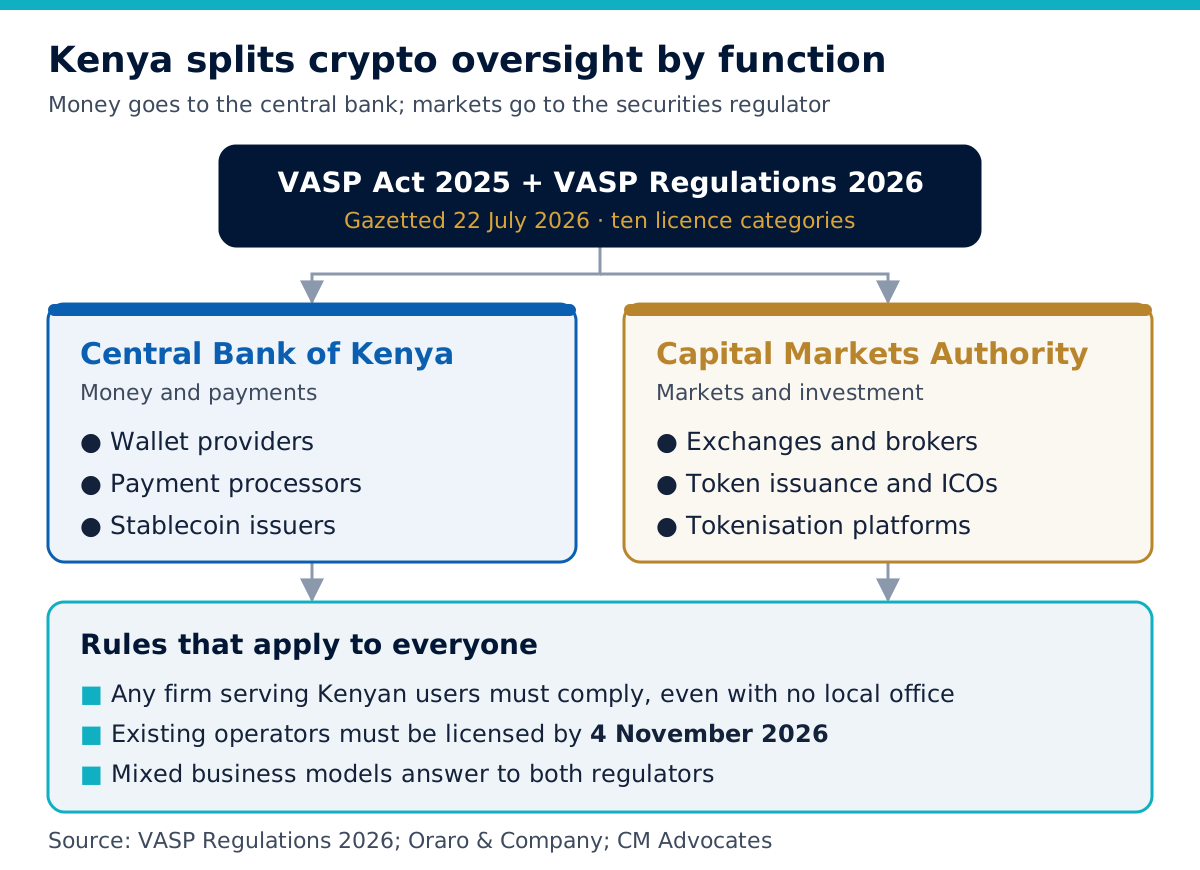
Kenya’s virtual asset framework: the Central Bank of Kenya oversees money and payments; the Capital Markets Authority oversees markets and investment.
Anything that touches payments and the value of money goes to the Central Bank of Kenya (CBK): wallet providers, payment processors and stablecoin issuers. Anything that touches trading, investing or raising capital goes to the Capital Markets Authority (CMA): exchanges, brokers, investment advisers, initial coin offerings and tokenisation platforms. A business that does both, such as an exchange that also offers a wallet, answers to both regulators (CM Advocates).
This matters more than it might seem. Crypto regulation elsewhere has often stalled in turf wars over whether a token is a security, a commodity or a currency. Kenya sidestepped the argument by looking at what a business does with the token. It is a pragmatic answer, and very much in the tradition that let mobile money flourish under existing banking law.
The price of entry
The regulations also set real capital thresholds, and this is where the market will feel the rules first (Khusoko):
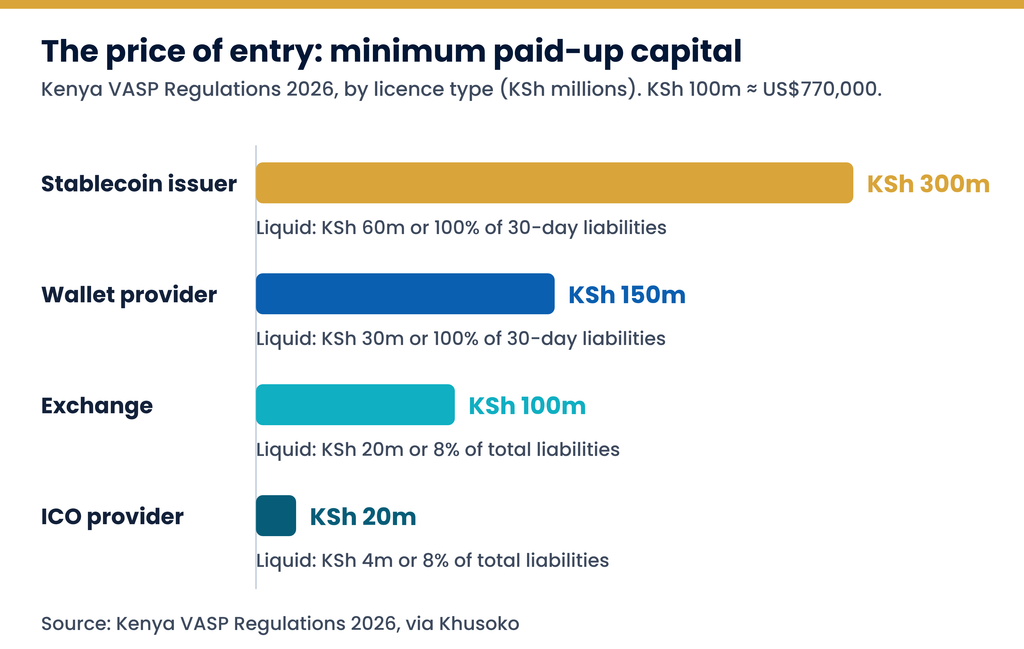
At current exchange rates, KSh 100 million is roughly US$770,000. For a well-funded international exchange, that is a rounding error. For a two-year-old Nairobi start-up, it is a serious hurdle. Early-stage Kenyan crypto firms are already reconsidering where to base their operations.
Stablecoins in Kenya: payment tools, not savings accounts
The most consequential choices in the regulations concern stablecoins: digital tokens designed to hold a steady value, usually one US dollar. Globally they have become the workhorse of crypto, and in Africa they do real economic work. Chainalysis finds that dollar-pegged stablecoins dominate the region’s activity, serving as a hedge against inflation and a way to move money across borders.
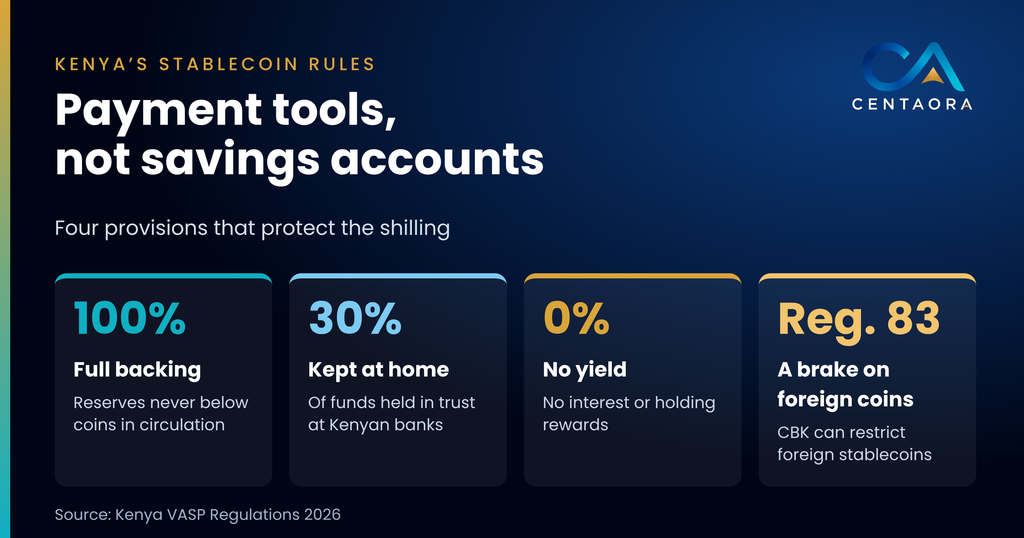
Kenya’s new crypto rules treat stablecoins strictly. Four provisions stand out (Khusoko; AU-Startups):
- Full backing, at all times. An issuer’s reserve assets must never fall below the value of the coins in circulation. Reserves are limited to cash, CBK balances, bank deposits, government securities maturing within 90 days and short-term repurchase agreements.
- Money stays partly at home. At least 30% of funds raised through a stablecoin issuance must sit in trust accounts at commercial banks in Kenya. Issuers must also run and report quarterly stress tests.
- No yield. Issuers may not pay interest or any reward linked to how long a customer holds the coins (AU-Startups).
- A brake on foreign coins. Regulation 83 lets the CBK direct licensed firms to restrict access to, or trading in, stablecoins issued outside Kenya.
Why this matters: Impact of Kenya’s New Crypto Rules on monetary sovereignty in a digital age
Read together, these provisions reveal the regulator’s real concern. It is not fraud or speculation, though both matter. It is currency substitution.
A dollar stablecoin on a phone is, functionally, a dollar account that sits outside the domestic banking system. For households and businesses in economies with volatile currencies, that is enormously attractive. It is also exactly what central banks fear. If enough savings migrate into foreign-issued digital dollars, the central bank loses some of its ability to steer interest rates, manage liquidity and protect the shilling.
The yield ban closes the most obvious route to that outcome. A stablecoin that pays interest competes with a bank savings account; one that pays nothing is mainly a payment tool. The trust-account rule keeps part of the backing money inside Kenyan banks. Regulation 83 gives the CBK an emergency brake on foreign coins.
This is a deliberate philosophical choice, and it puts Kenya closer to the European Union’s approach under MiCA, which also bans interest on e-money tokens, than to the United States. The US GENIUS Act framework bans issuer-paid yield but has left more room for rewards offered through exchanges. Kenya is saying, in effect: digital dollars are welcome as a way to pay, not as a place to save.
Who must comply with Kenya’s new crypto rules by 4 November
The VASP Act came into force on 4 November 2025 and gave existing operators exactly one year to get licensed. The regulations that make licensing possible arrived only in July, which leaves the industry a compressed window of about fifteen weeks to apply (CM Advocates).
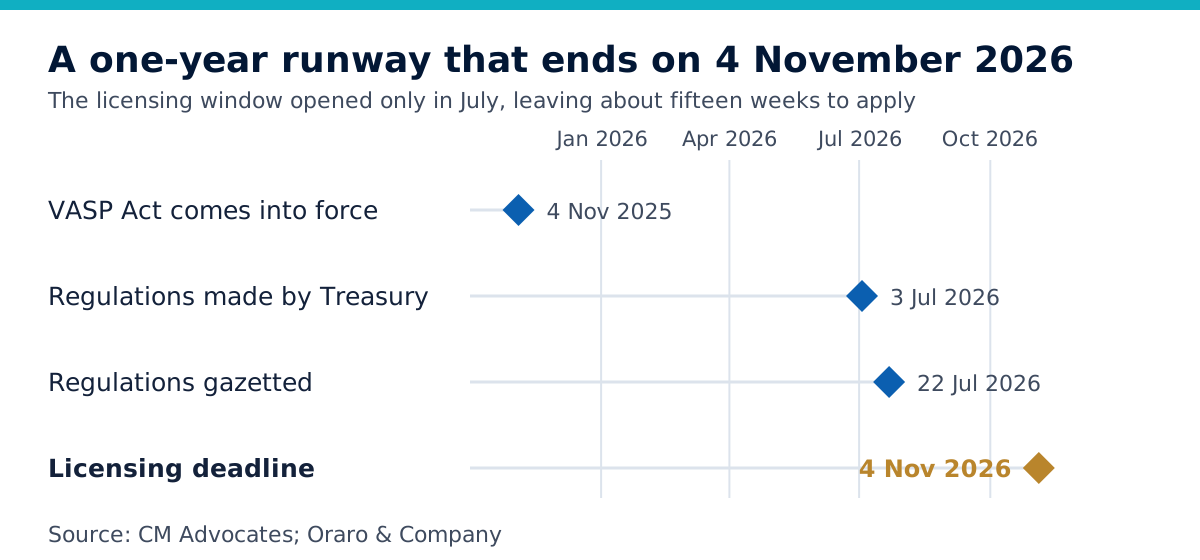
Key dates: the VASP Act took effect on 4 November 2025; the regulations followed in July 2026; the licensing deadline is 4 November 2026.
Three groups are caught by the deadline:
- Existing Kenyan operators. Exchanges, wallets, brokers, over-the-counter and peer-to-peer desks already serving customers must hold the right licence by 4 November or stop operating.
- New entrants. Any new virtual asset business must be licensed before it starts. There is no grace period for newcomers.
- Offshore platforms. This is the provision with the longest reach. A business is treated as operating “in or from Kenya” if it actively targets Kenyan consumers or earns economic benefit from Kenya, even without an office, staff or a local company (Oraro & Company).
That last point changes the market’s shape. Many Kenyans buy and hold crypto through large global apps. Those platforms now face a choice: license locally, geo-block Kenyan users, or operate in breach of Kenyan law. Each option carries cost, and their decisions over the coming weeks will determine what Kenyan users can actually access.
There is also a capacity question. At the time the regulations were gazetted, no provider had yet been licensed under the new law. Whether the CBK and CMA can review applications, check fit-and-proper requirements and issue licences in time is an open question. The regulators may well issue further guidance before the deadline; firms should watch for it closely.
How Kenya compares with South Africa and Nigeria
Kenya is not alone. The continent’s three most influential digital economies have now all brought crypto under formal regulation, but each took a strikingly different route.
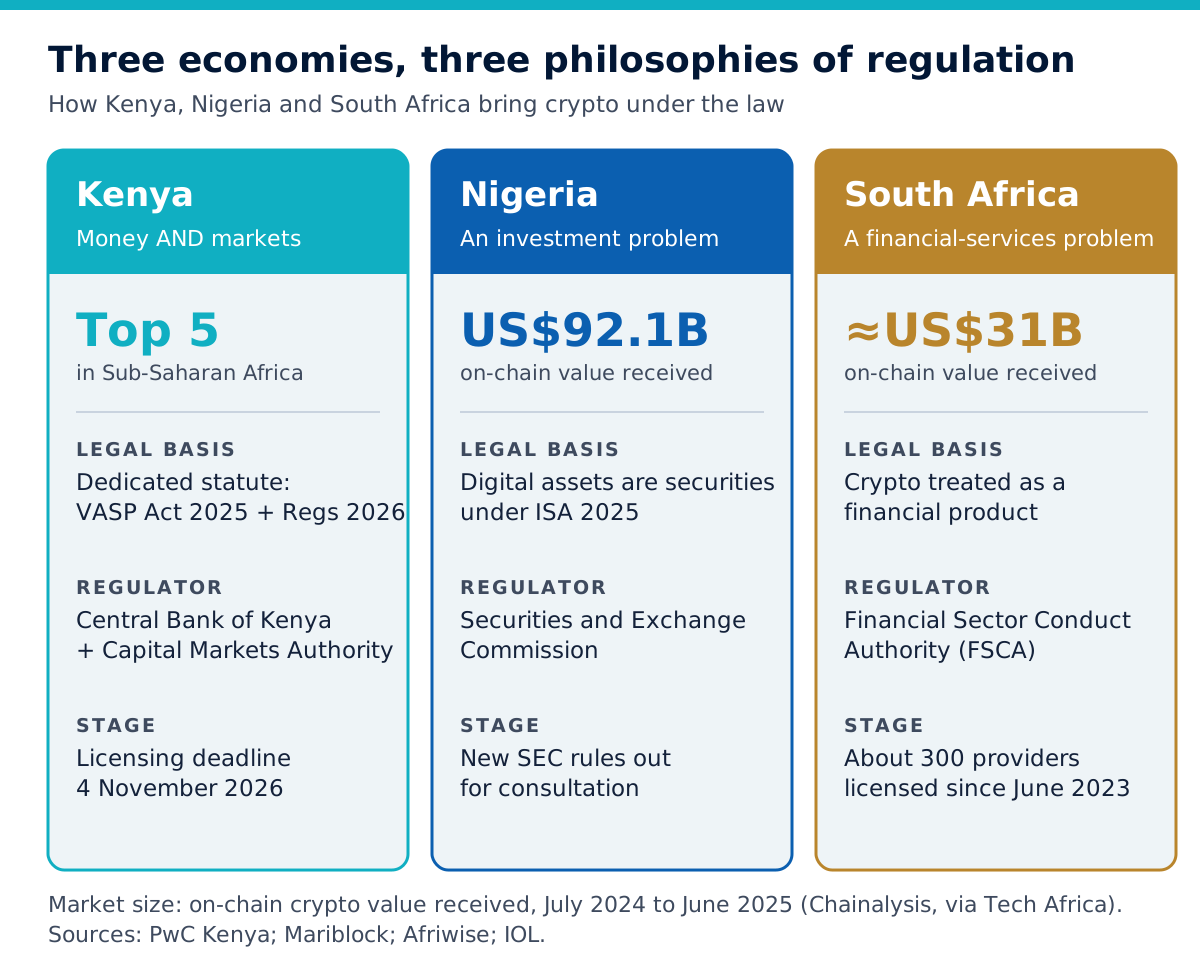
Three philosophies of regulation
The table hides a deeper difference in thinking.
Nigeria treats crypto as an investment problem
By folding digital assets into securities law, it places them under the regulator responsible for protecting investors. That fits a market where much activity is trading and saving in dollar-linked tokens.
South Africa treats crypto as a financial-services problem
It extended its existing licensing regime for financial advisers and intermediaries to crypto providers, and layered anti-money-laundering duties on top. The result is incremental and, by now, battle-tested.
Kenya treats crypto as both a money problem and a markets problem
It splits accordingly. It is the most explicit of the three on stablecoins, and it writes an explicit power to restrict foreign-issued coins into its rulebook.
The lesson from South Africa: licensing takes time
South Africa’s experience offers a useful reality check. Its licensing regime began in June 2023. By December 2025, two and a half years later, the FSCA had approved around 300 licences, with hundreds of applications still under review, and had opened 81 investigations into unlicensed operators (IOL).
Kenya is attempting the same transition with a fifteen-week application window. Either its regulators will move unusually fast, or the 4 November deadline will be followed by a period of pending applications and pragmatic enforcement. Both outcomes are plausible, and the difference matters for every business deciding whether to wait or to act now.
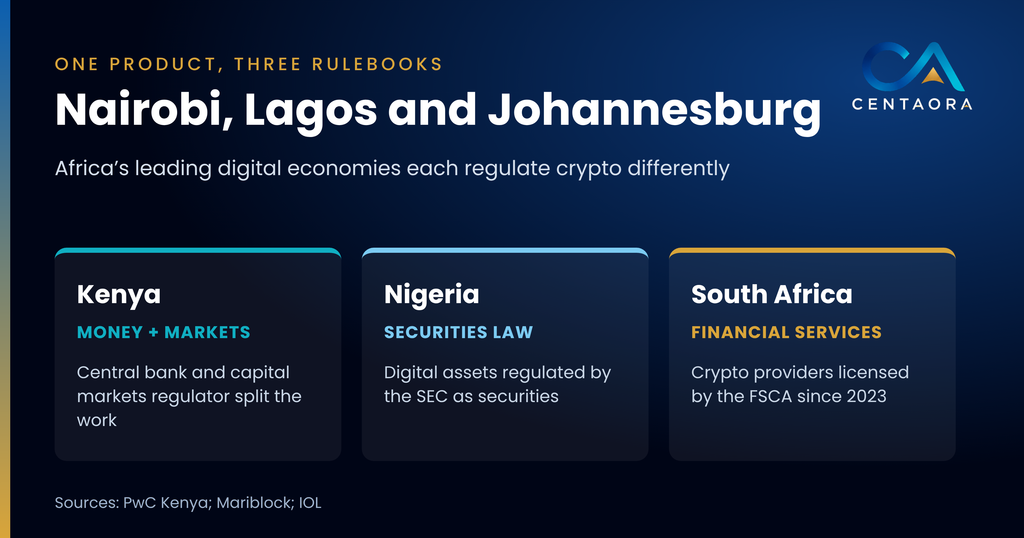
For anyone building across African borders, the practical consequence is clear: a single payments or crypto product will meet three different rulebooks in Nairobi, Lagos and Johannesburg. Compliance is becoming a market-by-market capability, and that favours firms large enough to carry it.
What Kenya’s crypto regulations mean for you
Fintech founders and crypto businesses
The immediate task is unglamorous: work out which of the ten licence categories your activities fall into, whether you answer to the CBK, the CMA or both, and whether you can meet the capital thresholds. If you can’t, the options are to partner with a licensed provider, narrow your product, or base the business elsewhere and stop targeting Kenyan users.
The longer-term picture is more encouraging. Regulation raises the cost of entry, but it also creates something the sector has lacked: legitimacy. Banks have been reluctant to serve crypto firms whose legal status was unclear. A licence changes that conversation, and it gives investors a clearer basis for backing Kenyan start-ups. The likely outcome is fewer firms, but stronger ones.
Remittance providers and the diaspora
Kenya received US$5.04 billion in diaspora remittances in 2025, about half of it from the United States. But growth slowed to just 1.9%, the weakest in more than fifteen years (ITWeb). With inflows flattening, every shilling lost to transfer fees matters more to the households that depend on them.
Stablecoins are already being used for this. One major exchange reports that Kenyans increasingly rely on crypto for remittances. Regulation could bring that activity into the light: a licensed, fully backed stablecoin, redeemable into shillings through a licensed wallet, is a plausible low-cost remittance rail. The yield ban will not hurt this use case at all; people sending money home want speed and low fees, not interest.
Non-profits and development organisations
As official aid budgets shrink, many organisations are looking for cheaper ways to move money across borders: grants to partners, cash transfers to beneficiaries, payments to field staff. Licensed digital-payment rails could reduce costs and speed up disbursement. The new rules give compliance teams something they previously lacked: a regulated counterparty in Kenya with a known supervisor. Organisations exploring this should insist on working only with licensed providers after 4 November.
Everyday users
For ordinary Kenyans who hold crypto, the change is mostly protective. Licensed providers must meet capital, governance, cybersecurity and complaint-handling standards. Before using any platform after 4 November, check that it is licensed by the CBK or CMA, read its risk disclosures, and know how to complain if something goes wrong (Oraro & Company). One caution: if a favourite global app suddenly restricts Kenyan accounts, move your funds through official channels rather than turning to unregulated peer-to-peer dealers.
What to watch after 4 November
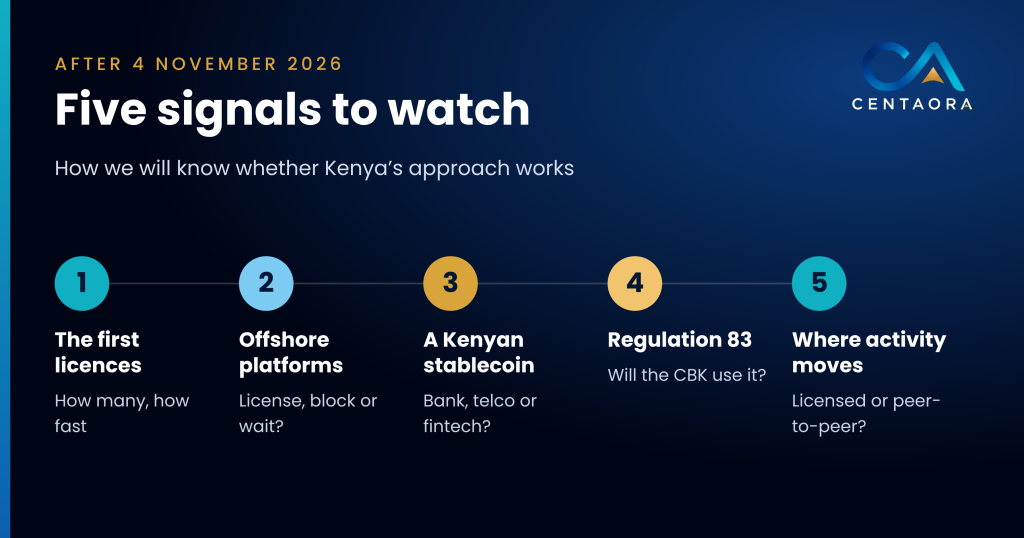
The regulations are written. The real story begins when they meet the market. Five signals will show whether Kenya’s approach works:
- The first licences. How many firms apply, how many are approved, and how quickly. A slow trickle would suggest capacity strain; a broad first cohort would signal confidence.
- Offshore platforms’ choices. Whether the large global apps license locally, restrict Kenyan users or wait. Their decisions will shape what most Kenyans can actually use.
- The first Kenyan stablecoin. A licensed, shilling-redeemable stablecoin with 30% of its reserves held in local banks would be a genuine first. Watch who issues it: a bank, a telco or a fintech.
- Whether Regulation 83 is used. If the CBK ever restricts a foreign stablecoin, it will signal how seriously it views currency substitution.
- Where activity moves. If licensed channels are too costly or slow, some activity will shift to unregulated peer-to-peer markets. That is the outcome every regulator wants to avoid.
The Centaora Signal
Kenya’s virtual asset regulations are one part of a wider pattern traced in the September edition of The Centaora Signal. Across the world, regulators are moving programmable money from debate into rulebooks, while the AI build-out runs into shortages of memory, power and skilled people. The edition calls this the quarter in which scarcity revealed structure.
Let’s Know….
Need to understand what these rules mean for your organisation? Centaora supports businesses, non-profits and institutions with strategic briefings, landscape analysis and research synthesis.
Sources for Further Reading
- Oraro & Company, Virtual Asset Service Providers Regulations 2026 (legal alert)
- PwC Kenya, Legal alert: Virtual Asset Service Providers Regulations 2026
- CM Advocates, The Virtual Asset Service Providers Regulations, 2026
- Khusoko, Kenya VASP Regulations 2026: capital requirements
- AU-Startups, Kenya gazettes new crypto regulations, bans stablecoin interest
- AU-Startups, Kenya CBK foreign stablecoin access restriction
- AU-Startups, Kenya crypto rules pressure homegrown startups
- Tech Africa, Sub-Saharan Africa took in $205bn in crypto (citing Chainalysis)
- ITWeb, Kenya remittances hit $5bn in 2025 as growth slows
- AllAfrica, Kenyans increasingly rely on crypto for remittances
- Mintmark Brief, Stablecoins and tokenization, week ending 21 August 2026
- Mariblock, Nigeria’s president signs bill recognizing digital assets into law
- Afriwise, Nigeria’s digital asset regulatory reset
- IOL Business Report, FSCA approves 300 crypto service providers