
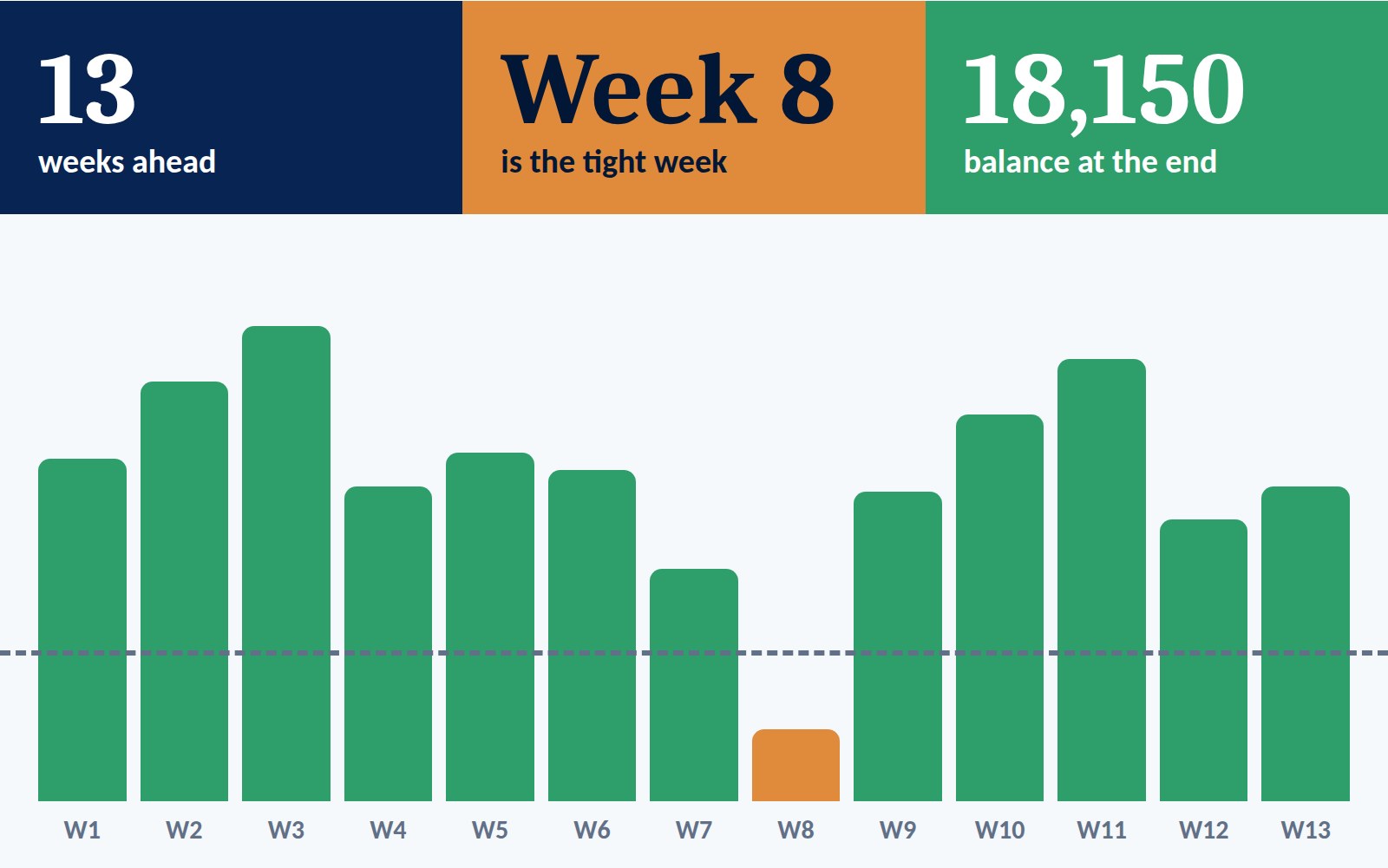
A 13-week cash flow forecast shows how much money your business will have in the bank at the end of each of the next 13 weeks. It is the simplest way to see a cash shortfall before it arrives, while there is still time to act. This guide explains what a 13-week cash flow forecast is, how to build one in five steps, and how to use it every week. A free Cash Flow Planner is linked at the end.
What is a 13-week cash flow forecast?
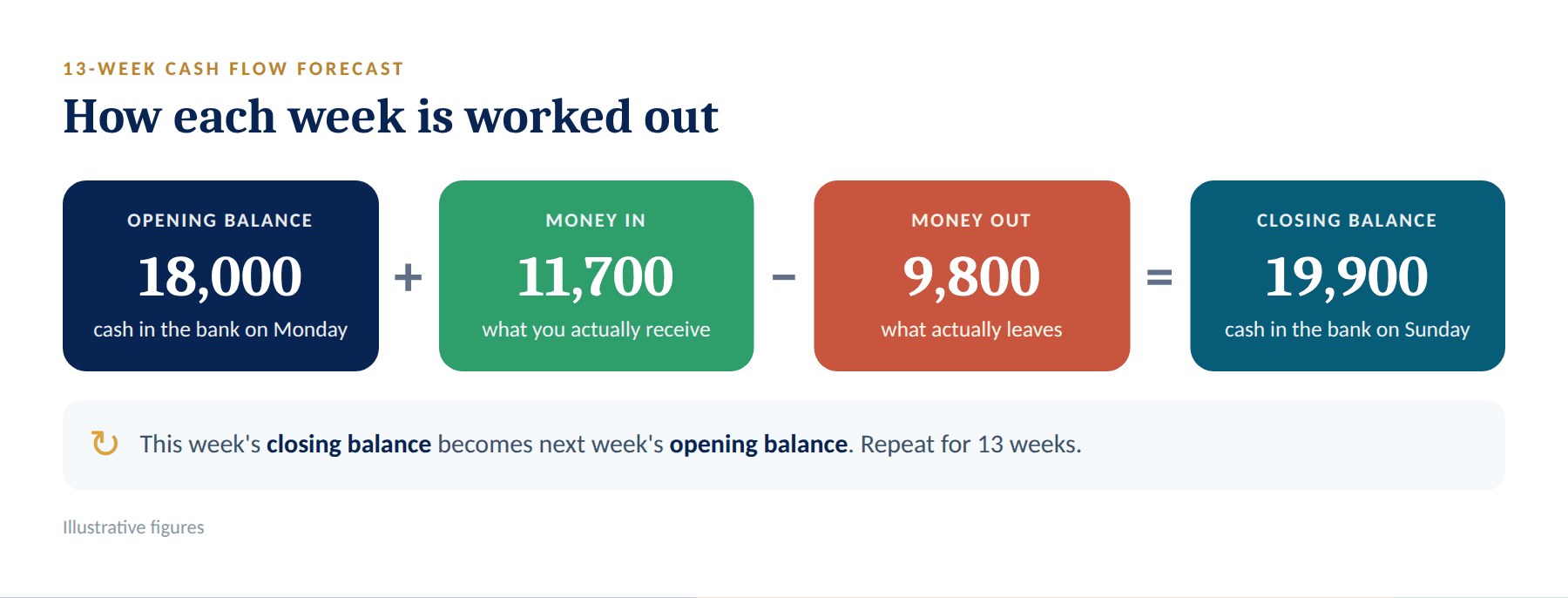
A 13-week cash flow forecast is a week-by-week plan of the cash you expect to receive and the cash you expect to pay over the next quarter. Each week starts with an opening balance, adds money in, takes away money out, and ends with a closing balance that becomes the next week’s opening balance.
Thirteen weeks is used because it covers a full quarter. That is long enough to include quarterly bills such as tax and rent, and short enough that the figures can still be reasonably accurate. It works in weeks, not months, because cash problems happen in weeks: a business can be profitable for the month and still be unable to pay salaries on the 25th.
Why cash flow forecasting matters for small businesses
Profit and cash are different things. Profit is what is left after costs on paper. Cash is what is in the bank today. A growing business often has less cash, not more, because it pays for stock and staff before customers pay their invoices.
Late payment makes this worse. In QuickBooks’ 2026 late payments report, 59 per cent of small businesses were carrying overdue invoices, and about four in ten had struggled to cover payroll or bills because of a single late payment. A UK survey of 1,000 small business leaders, reported by Global Banking and Finance Review, found that 82 per cent had experienced cash flow problems and that one in three could not correctly define cash flow.
A forecast does not create cash. It gives you warning. Knowing in week 2 that week 8 will be tight leaves six weeks to chase invoices, stage a payment or arrange a facility. Finding out in week 8 leaves none.
How to build a 13-week cash flow forecast in five steps
- Start with the cash you have today. Add together every business bank account and any cash on hand. This is your opening balance. Do not include money you are owed.
- List the money coming in, in the week it will arrive. Use the date you expect to be paid, not the date you invoice. If a customer usually pays two weeks late, forecast it two weeks late.
- List the money going out, in the week it leaves your account. Include suppliers, salaries, rent, utilities, loan repayments and tax. Check for anything paid once a quarter or once a year that falls inside the 13 weeks.
- Work out the closing balance for each week. Opening balance plus money in, minus money out. Carry each closing balance forward as the next week’s opening balance.
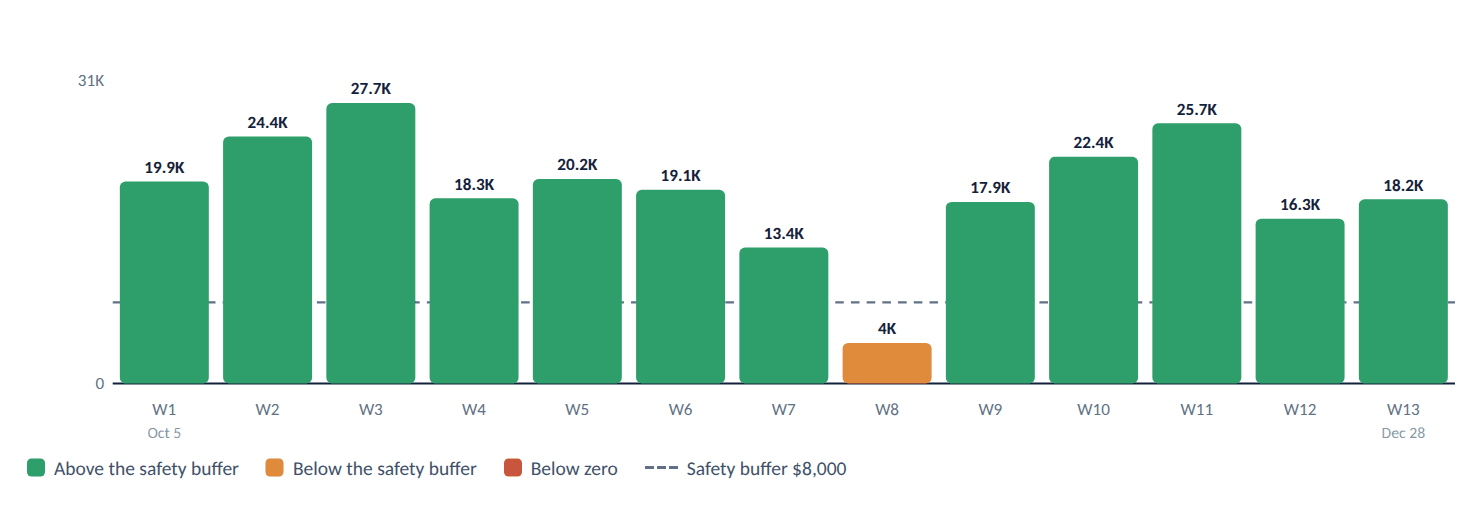
- Set a safety buffer and look for the low point. Decide the least you want to keep in the bank. A common starting point is four weeks of costs. Then find the week with the lowest closing balance: that is the week to plan for.
How to read the forecast
- The lowest balance tells you how much headroom you have, and in which week.
- Any week below zero is a shortfall. You need that much extra cash by then, or you need to move that much spending later.
- Any week below your safety buffer is a warning. The business survives, but one surprise would cause trouble.
- The heaviest week for money out is usually payroll week or a tax week. Check that enough arrives before it.
Test it: what if customers pay late?
A forecast shows one version of the future. The useful question is what happens when that version is wrong. Three tests cover most situations: customers pay two to four weeks late, sales fall by a fifth, or costs rise by a tenth.
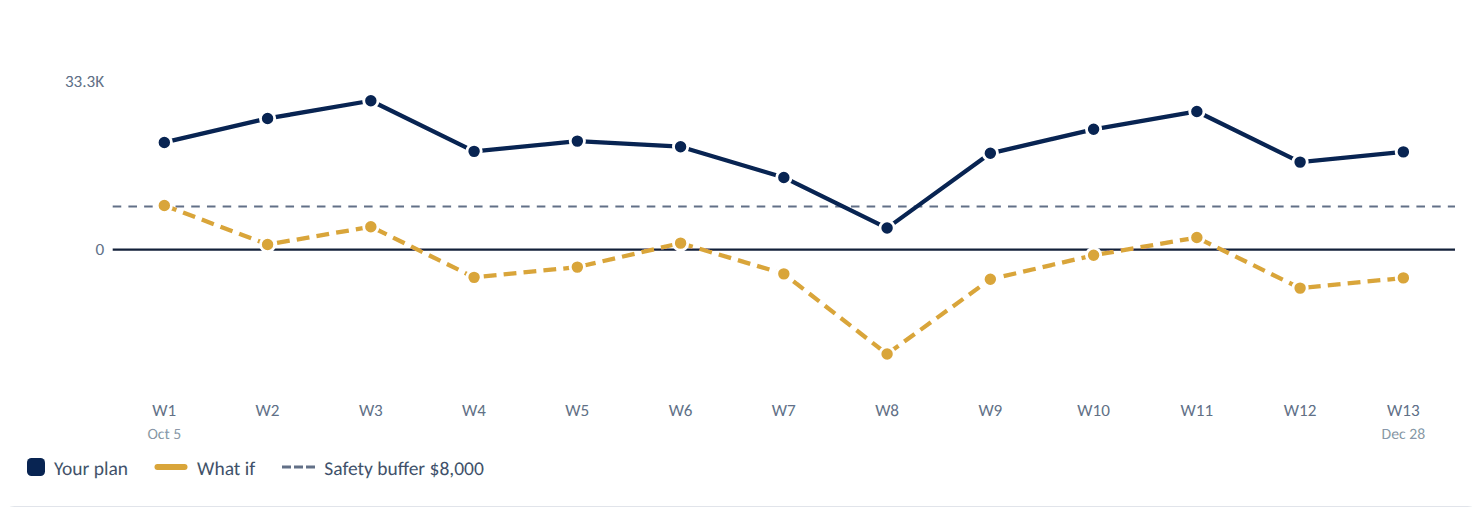
If the forecast survives all three, the business has room to breathe. If one of them takes the balance below zero, you have found the risk to manage, and you have found it early.
What to do when the forecast shows a shortfall
- Bring money in sooner. Invoice the day the work is done, shorten payment terms, and call about invoices before they are overdue.
- Ask suppliers for time. Longer terms or staged payments for the tight weeks cost less than a missed payment.
- Delay what can wait. Equipment, marketing and new hires can often move by a month.
- Agree a tax payment plan early. Tax authorities are generally easier to deal with before a deadline than after it.
- Arrange finance while the forecast still supports it. A lender is more willing when you can show when the money will be repaid.
Make it a weekly habit
A forecast built once is out of date within a fortnight. The method that works is a rolling forecast. Every Monday, replace week 1 with what actually happened, move every week up by one, and add a new week 13. It takes about fifteen minutes, and after a month you will also know how accurate your forecasting is.
Try the Cash Flow Planner
The Cash Flow Planner is Centaora’s free 13-week cash flow forecast tool. It works in any currency and needs no spreadsheet. Add your money in and money out, and it draws the balance week by week, flags the weeks that are tight, lets you test late payments with a slider, and rolls the forecast forward each week. You can save it as a PDF, download it for Excel or share it. Your figures stay in your own browser.
Frequently asked questions
Why 13 weeks and not 12 months?
Thirteen weeks is one quarter. It is near enough to forecast with real invoices and bills, and long enough to act on what you see. A 12-month forecast is useful for planning but too coarse to manage cash.
Is a cash flow forecast the same as a budget?
No. A budget plans income and costs for the year. A cash flow forecast shows when money actually arrives and leaves, which is what decides whether you can pay a bill.
Do I need accounting software?
No. You need your bank balance, a list of what you expect to be paid, and a list of what you have to pay.
Will a lender accept a 13-week cash flow forecast?
Many lenders ask for one, especially for short-term facilities. It shows that you know when the money is needed and when it can be repaid. Add a note of your main assumptions.
How accurate should it be?
The first four weeks should be close, because most of the invoices and bills already exist. Later weeks are estimates, which is why the forecast is updated every week.
Cash flow is one of seven areas measured by the Strategic Readiness Index, a free assessment of how ready a business is to grow. For the wider picture, read the guide to business readiness assessment.