
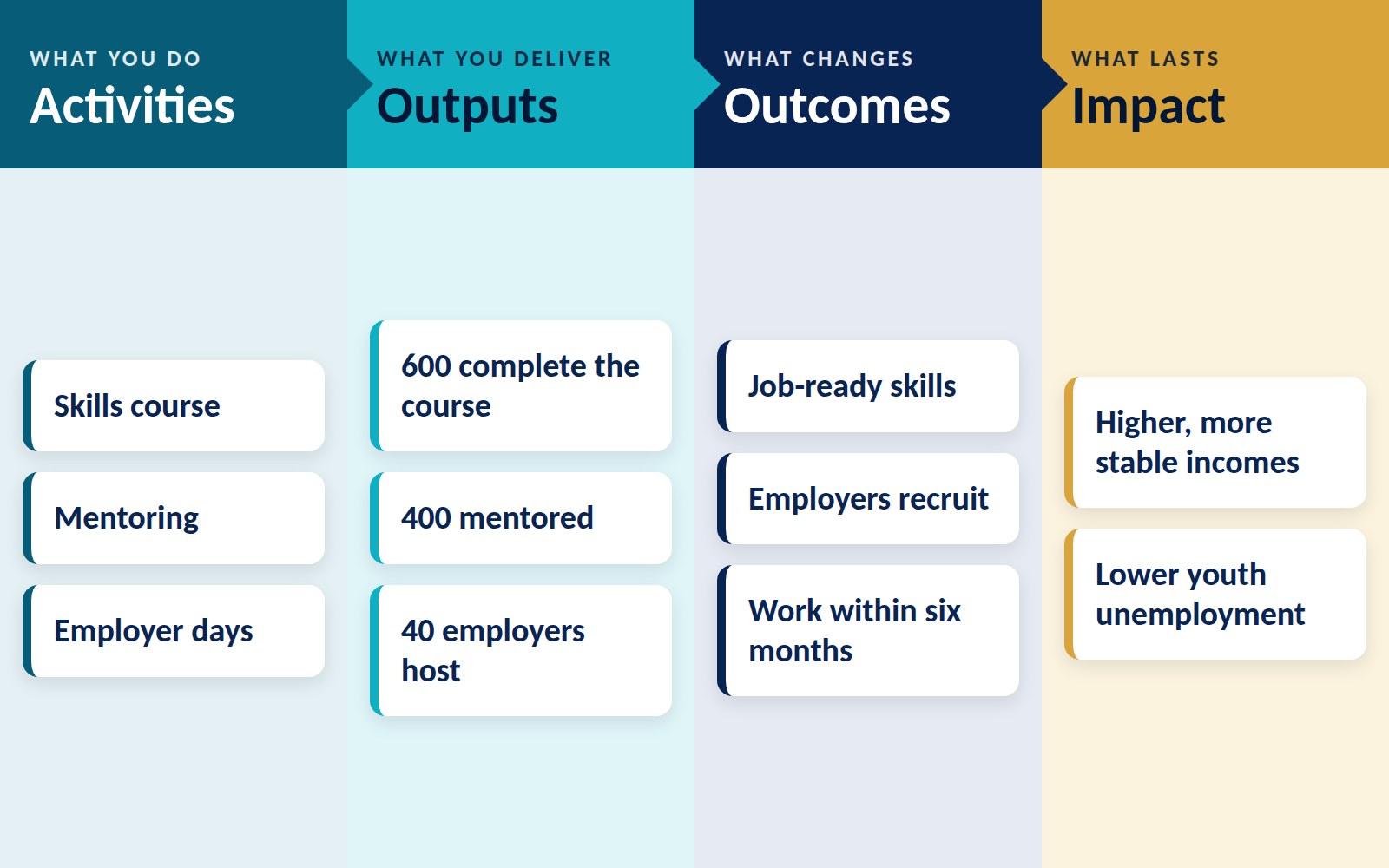
A theory of change explains how and why your work is expected to lead to the change you want. It is the logic behind a project: what you will do, what that will produce, what will change for people as a result, and what has to hold true along the way. This guide shows how to write a theory of change step by step, with a worked example and a free online tool to draw yours.
What is a theory of change?
A theory of change is a short, structured account of how change happens. Most are drawn as a results chain that reads from left to right: activities lead to outputs, outputs lead to outcomes, and outcomes contribute to a lasting impact.
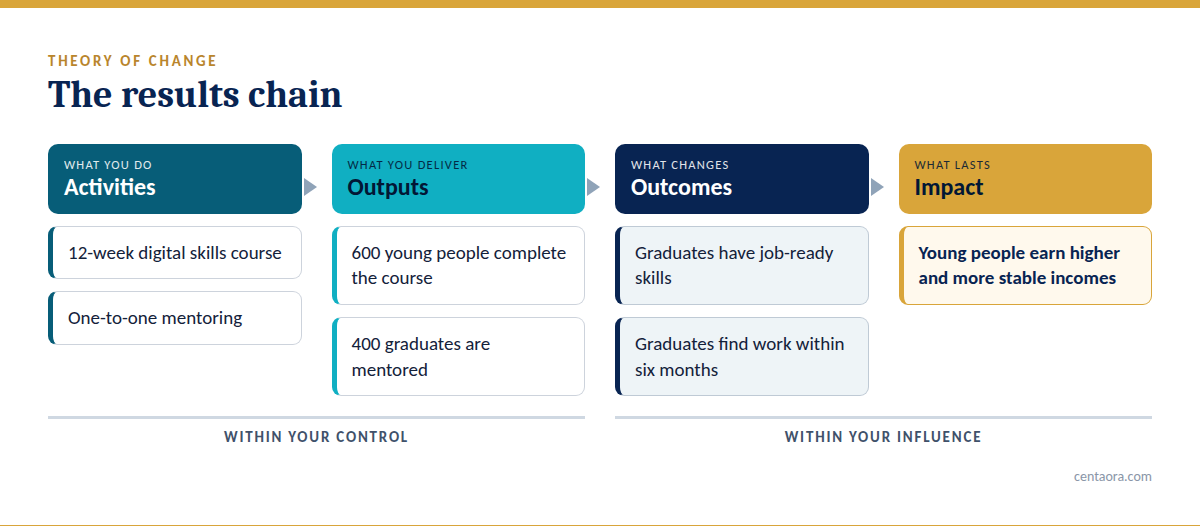
The first two links are within your control. You decide what to do and you can count what you deliver. Outcomes and impact are within your influence, not your control, which is why a good theory of change also names the assumptions it rests on.
Why write a theory of change before the proposal?
- It exposes gaps early. If no activity leads to an outcome you have promised, you find out on paper and not in year two.
- It gets the team to agree. People often share a project and hold different pictures of what it is for. Drawing the logic settles that.
- It makes monitoring easier. Once each outcome is written down, choosing indicators for it is a short step.
- Funders ask for it. Many application forms now require a theory of change or a logical framework, and the first is the simplest route to the second.
How to write a theory of change in seven steps
Work backwards. Start from the change you want and ask what must happen first. Starting from your activities tends to produce a list of things you already do.
- Describe the background. Write a problem statement: what is wrong, who is affected, and why it matters now. List the challenges you are addressing and the barriers to change.
- State the overall objective. One sentence on what the project sets out to achieve, for whom, where and by when.
- Name the long-term change. This is the impact: the wider, lasting difference your work contributes to. You will not achieve it alone.
- Set the outcomes. Outcomes are changes for the people you work with, in what they know, can do or do differently. Separate short-term outcomes, seen within months, from long-term outcomes, seen in one to three years.
- List the outputs. Outputs are what you deliver: people trained, guides published, sessions held. Link each output to the outcome it contributes to.
- Plan the activities. The work itself. Each activity should produce at least one output.
- Write down the assumptions and risks. Assumptions are conditions outside your control that must hold. For each risk, add what you will do about it.
One test separates outputs from outcomes: if you can guarantee it by working harder, it is an output.
Test your logic: if, then, because
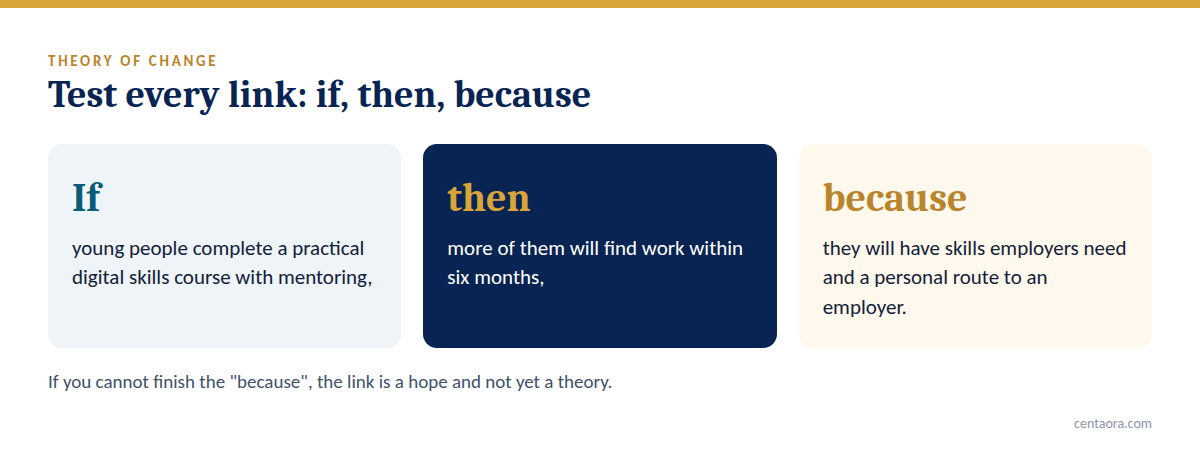
Every link in a theory of change should survive one sentence: if we do this, then this will change, because of this reason. If you cannot finish the “because”, the link is a hope and not yet a theory. Either find the evidence or record it as an assumption to test.
A theory of change example
Take a programme that helps young people into work through digital skills training.
- Overall objective: equip 600 young people in two counties with job-ready digital skills and a direct route into work by 2028.
- Activities: a 12-week digital skills course, one-to-one mentoring, employer placement days.
- Outputs: 600 young people complete the course; 400 graduates are mentored; 40 employers host placement days.
- Short-term outcomes: graduates have job-ready skills and confidence; employers recruit from the programme.
- Long-term outcome: graduates find work or start earning within six months.
- Impact: young people in the two counties earn higher and more stable incomes.
- Key assumption: local employers continue to have vacancies that need these skills.
In one sentence: if young people complete a practical course with mentoring and meet employers directly, then more of them will find work within six months, because they will have skills employers need and a personal route to an employer.
Common mistakes to avoid
- Writing activities as outcomes. “Train 600 young people” is an activity. The outcome is what changes for them afterwards.
- Putting several ideas in one box. One result per box keeps the diagram readable and makes each result measurable.
- Leaving assumptions unspoken. Unwritten assumptions are the ones that surprise you later.
- Building it alone. A theory of change written by one person is rarely owned by the team that has to deliver it.
- Never looking at it again. Revisit it at least once a year and ask whether the assumptions still hold.
Build your theory of change online, free
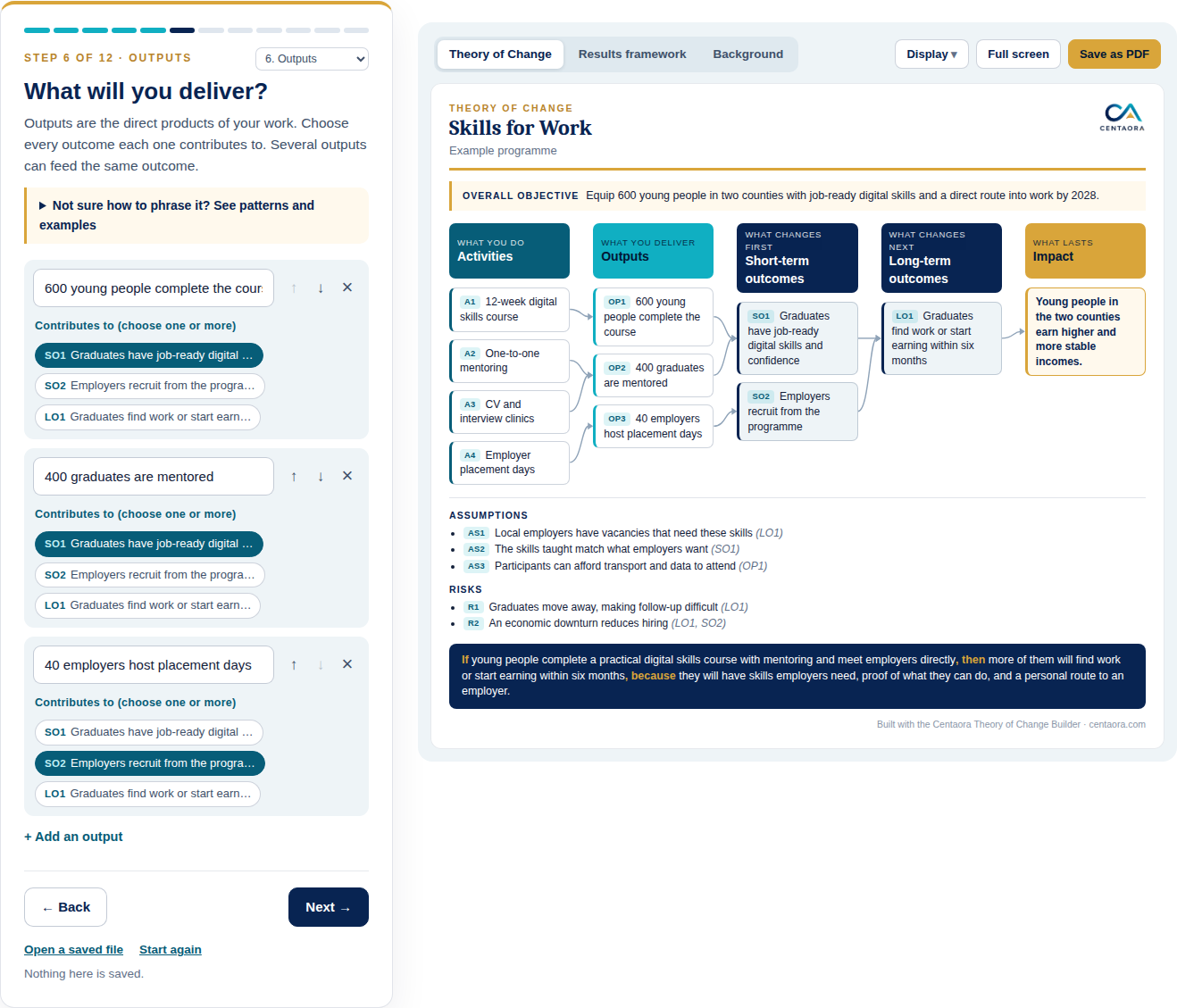
The Centaora Theory of Change Builder walks you through these steps and draws the diagram as you type. It checks your logic, gives every item a code, and builds a results framework with indicators, assumptions, and risks with mitigation measures. You can save the result as a PDF, open it in Word, or share a link with colleagues.
Open the Theory of Change Builder, or see all the practitioner toolkits.
Frequently asked questions
What is the difference between a theory of change and a logframe?
A theory of change explains how and why change is expected to happen, including the assumptions. A logframe, or logical framework, sets the same results out in a table with indicators and targets for managing and reporting. Write the theory of change first; the logframe follows from it.
How long should a theory of change be?
One page for the diagram is enough for most projects, with a short background alongside it. If the diagram needs more than one page, the project may be trying to do too much, or boxes may hold more than one idea.
Who should be involved in writing it?
The people who will deliver the work, and where you can, the people it is meant to benefit. A half-day workshop with a draft on the wall usually does more than weeks of solitary drafting.