
Ambition is powerful.
It can wake you early, stretch your imagination and make you believe that your life can become larger than its current circumstances. It can help you apply for the opportunity, begin the business, return to school, pursue leadership or finally take a dream seriously and invest in personal capacity building.
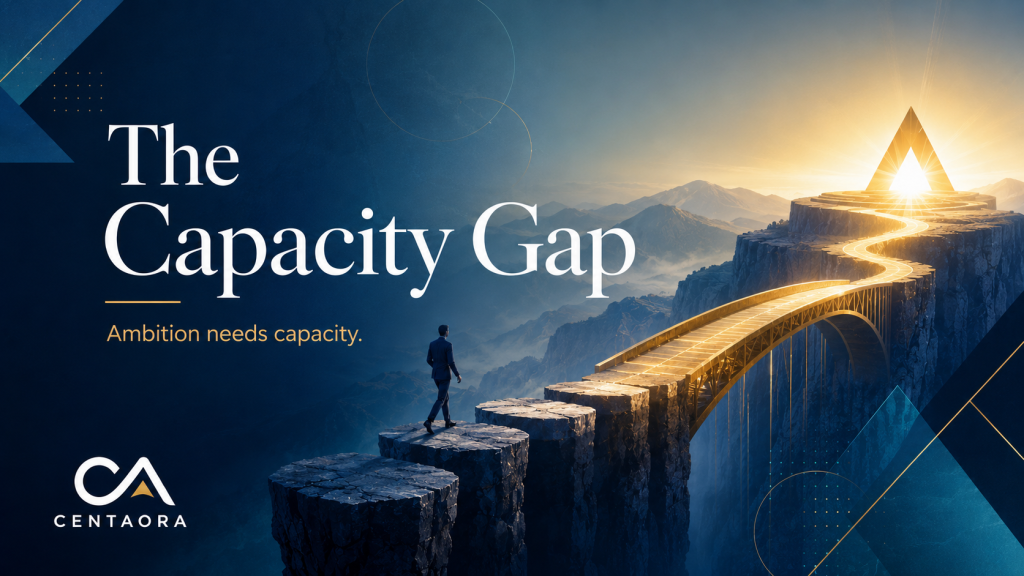
But ambition has limits.
It can show you where you want to go without preparing you for what that destination will demand from you.
You may sincerely desire a better career, stronger relationships, financial freedom, meaningful leadership or a more purposeful life. Yet wanting the next level does not automatically give you the skills, discipline, emotional strength, systems or support required to sustain it.
Between where you are and where you want to go, there is often a capacity gap.
Understanding that gap can change how you approach personal growth and personal capacity building.
Instead of asking only, “How badly do I want this?” you begin asking a more useful question:
What must I develop to become capable of carrying what I desire?
That is where real transformation begins.
What is a capacity gap?
A capacity gap is the distance between your current ability and the demands of the future you want to create.
It may involve a lack of knowledge or technical skill. But capacity is broader than competence alone.
It also includes your ability to:
- make sound decisions;
- manage time and energy;
- regulate emotions;
- communicate clearly;
- remain disciplined;
- handle greater responsibility;
- recover from setbacks;
- build supportive relationships;
- organise resources;
- and act consistently without constant external pressure.
Imagine that you want to move into senior leadership.
Your ambition may be genuine. Your qualifications may even be strong. But the role may require you to manage conflict, communicate under pressure, delegate effectively, think strategically and make difficult decisions with incomplete information.
The gap is not between you and the title.
It is between your current capacity and the responsibilities attached to that title.
The same applies to business, parenting, relationships, creativity, public service, health and personal finance.
Every meaningful next season places new demands on us.
Ambition starts the journey, but capacity sustains it
Ambition gives you momentum.
Capacity gives you staying power.
Ambition may help you win an opportunity. Capacity determines whether you can manage it well.
Ambition may push you to launch a business. Capacity helps you build systems, understand customers, manage money, lead people and survive uncertainty.
Ambition may lead you into a relationship. Capacity helps you communicate, remain vulnerable, resolve conflict and build trust.
Ambition may inspire you to become healthier. Capacity helps you develop routines that continue after motivation fades.
This is why people sometimes achieve the very thing they prayed for and still feel overwhelmed by it.
The opportunity arrived before the capacity was fully built.
That does not mean they were undeserving. It means the next phase of growth must move beyond desire and into development.
The hidden demands of your next season
We often romanticise the future.
We picture the promotion, the successful business, the peaceful home, the respected leadership role or the visible impact. We imagine the outcome, but not always the weight attached to it.
Every new season has visible rewards and invisible requirements.
A larger platform may require thicker skin.
Greater income may require stronger financial discipline.
More influence may require greater integrity.
A growing organisation may require delegation.
A healthy partnership may require emotional openness.
A meaningful legacy may require patience over many years.
The future does not only ask:
What do you want?
It also asks:
What are you prepared to carry responsibly?
This is not meant to reduce your confidence. It is meant to deepen it.
Real confidence is not simply believing that you can do something. It is building the capacity that gives that belief a solid foundation.
Five areas of personal capacity
Personal capacity building becomes easier when you understand what needs to be developed.
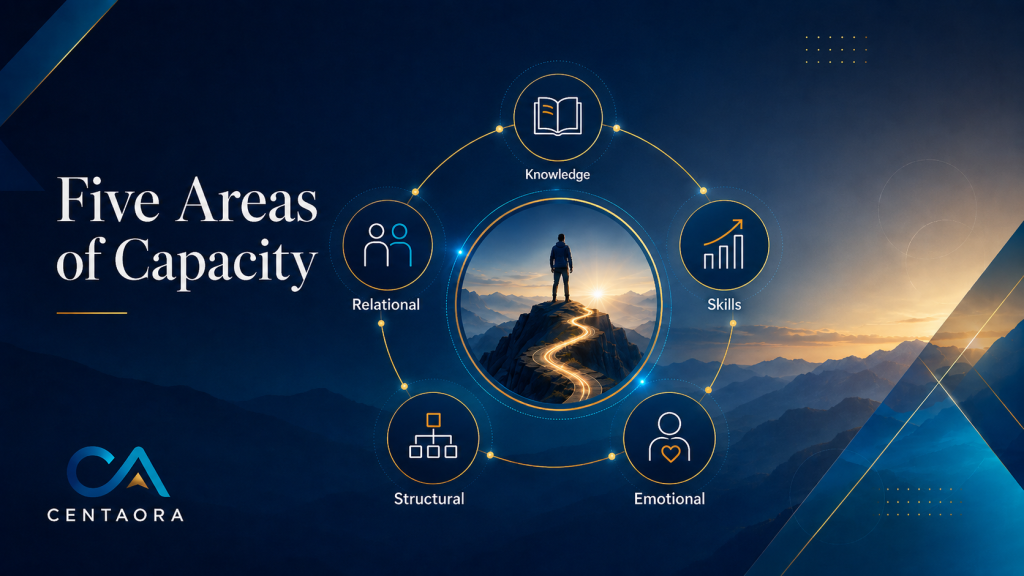
The following five areas provide a practical starting point.
1. Knowledge capacity
This is what you need to understand.
It may include technical knowledge, industry awareness, financial literacy, leadership principles or knowledge about your own behaviour.
Ask yourself:
- What do I not yet understand?
- What information would improve my decisions?
- What assumptions am I making without evidence?
- Who has knowledge I need to learn from?
Knowledge can be gained through books, courses, observation, experience, research and conversation.
However, knowledge alone is not transformation. It must eventually influence how you act.
2. Skill capacity
Skills are your ability to apply what you know.
You may understand communication in theory but still struggle to express disagreement calmly. You may understand budgeting but fail to manage spending consistently.
For personal capacity building, skills are developed through practice, feedback and repetition.
They may include:
- communication;
- negotiation;
- planning;
- writing;
- financial management;
- problem-solving;
- leadership;
- technology;
- decision-making;
- and conflict resolution.
Your next season will usually require a combination of technical and human skills.
3. Emotional capacity
Some opportunities demand more emotional strength than we expect.
Can you receive criticism without collapsing?
Can you remain calm when plans change?
Can you tolerate uncertainty?
Can you say no without excessive guilt?
Can you ask for help without feeling inadequate?
Emotional capacity is not the absence of difficult feelings. It is the ability to experience those feelings without allowing them to govern every decision.
As responsibility grows, emotional maturity becomes increasingly important.
4. Structural capacity
Many people do not fail because they lack talent. They fail because they lack systems.
Structural capacity includes the routines, tools and processes that make progress repeatable.
It may involve:
- a realistic schedule;
- a financial system;
- a project tracker;
- clear priorities;
- healthy boundaries;
- documented processes;
- a weekly review;
- or a dependable support structure.
Motivation is unpredictable.
Systems reduce the amount of energy required to keep beginning again.
5. Relational capacity
No meaningful future is built alone.
Your capacity is influenced by the people around you.
You may need:
- a mentor;
- a professional network;
- trusted friends;
- collaborators;
- honest feedback;
- emotional support;
- or people who understand the responsibilities you carry.
Relational capacity also includes your ability to build trust, communicate expectations and maintain healthy relationships as your life changes.
Sometimes the gap is not a missing skill.
It is isolation.
Why capable people still feel stuck
Many intelligent and hardworking people become frustrated because they assume effort should automatically produce progress.
When it does not, they may conclude that they are not talented enough or that the opportunity was never meant for them.
But sometimes the problem is more specific.
They may be applying greater effort to a capacity problem.
Working longer will not solve a lack of strategic direction.
Thinking positively will not replace financial knowledge.
Setting larger goals will not correct poor systems.
Waiting for confidence will not develop a skill that requires practice.
This is why honest self-assessment matters.
You do not need to condemn yourself for what is missing. You need to identify it clearly enough to build it.
Capacity building is not self-rejection
There is a difference between recognising a growth need and believing you are inadequate.
Personal capacity building does not mean that you are not enough as a human being.
Your worth is not under examination.
Your preparedness is.
You can respect who you are today while still developing what tomorrow requires.
This is a healthier approach to growth because it avoids two extremes:
- pretending you are already prepared for everything;
- or treating every weakness as proof that something is wrong with you.
You can simply say:
I am worthy now, and I am still developing.
That is both honest and empowering.
Your next season may require a new version of discipline
Discipline is often described as pushing yourself harder.
But mature discipline is not always force.
Sometimes it is restraint.
It is choosing fewer goals so that your attention is not scattered.
It is protecting sleep because exhaustion is weakening your judgement.
It is declining opportunities that do not align with your direction.
It is creating routines that reduce chaos.
It is completing important work before chasing new ideas.
It is asking for accountability when private intention is not enough.
The discipline needed for your next season may not look dramatic. It may look like consistency, boundaries and a willingness to keep doing the unglamorous work.
A practical capacity-gap exercise
Choose one goal or future role that matters to you.
Write it clearly:
In the next 12 to 24 months, I want to…
Then complete the following five sections.
1. What will this future require me to know?
List the knowledge you will need.
2. What must I be able to do well?
Identify the practical and relational skills required.
3. What emotional pressures will I need to manage?
Consider uncertainty, criticism, responsibility, visibility, conflict or change.
4. What systems will support me?
List the routines, tools, boundaries and resources you need.
5. Who will help me grow?
Identify mentors, peers, collaborators or specialists who can support you.
Now rate your current capacity in each area from 1 to 10.
Do not judge yourself. Observe honestly.
The lowest score is not evidence of failure.
It is information.
It tells you where development may create the greatest movement.
Turn the gap into a development plan
Once you identify the gap, avoid trying to improve everything at once.
Choose one or two priority areas.
For each one, define:
- the capacity you need to build;
- one practical action;
- one source of support;
- one way to practise;
- and one date for review.
For example:
Capacity needed: Confident public speaking
Action: Join a speaking group and practise twice each month
Support: Ask an experienced speaker for feedback
Practice: Record one five-minute presentation weekly
Review date: Three months from now
This is how ambition becomes structured growth.
You move from a vague desire to a deliberate development process.
Do not wait until the opportunity arrives
One of the best times to build capacity is before you urgently need it.
Learn financial discipline before your income grows.
Develop communication skills before conflict becomes severe.
Practise delegation before you are overwhelmed.
Build credibility before you need public trust.
Strengthen your health before exhaustion forces you to stop.
Create systems before growth becomes chaotic.
Preparation may feel invisible, but it is never wasted.
Many seasons are sustained by work that began quietly long before anyone saw the outcome.
Your future should influence how you grow today
Strategic life planning is not only about deciding where you want to go.
It is also about identifying who you must become and what you must develop along the way.
A useful future vision should influence your present learning, habits, relationships and decisions.
It should help you recognise which opportunities deserve your attention and which distractions are simply attractive.
When your development is connected to a meaningful direction, growth becomes less random.
You are not trying to improve everything.
You are building the capacity required for a specific future.
The Centaora perspective
At Centaora, personal growth is not treated as endless self-improvement.
It is about becoming sufficiently prepared to live, lead and contribute with greater purpose.
Capacity building connects ambition to responsibility.
It asks us to honour our dreams by preparing for them.
It reminds us that becoming ready is not separate from the journey.
It is the journey.
Your next season may not require you to desire more.
It may require you to develop more deeply.
More skill.
More structure.
More courage.
More patience.
More support.
More self-leadership.
Ambition can point toward the future.
But capacity is what enables you to enter it, carry it and remain whole within it.
A question to carry with you
Do not ask only:
How can I reach the next level?
Also ask:
What capacity must I build to lead myself well when I arrive?
That question can change everything.
Lead with purpose.
Build the capacity for your future.
Leave a legacy you are prepared to carry.